25 February 2021

▶︎ Toppermost of the poppermost: the charts

Occasionally a visitor to my website emails that they are not happy about the chart placings that I list for Australian records. They are usually people who are heard on those very records. That is to say, artists.

There are two sources of disappointment: The Legendary International Hit and My Record Did Better Than That! The quotes below are not real examples. I'm improvising around the theme of emails I've had over the years from artists about the insultingly low chart placings I've listed for their records from the 50s, 60s, or 70s.

1. The Legendary International Hit
• Our manager definitely told us we were #10 in Los Angeles.
• We were shafted by the Aussie music business, but our record charted Top 20 in Pennsylvania!
• Oh yeah, we were big all over the world. #1 in Sweden, Greece and Czechoslovakia.

These claims are nearly always wrong, and I usually know that before I've checked the sources. 

You can also see statements like these in old newspaper stories. Back then, who was going to check any of this? There were no obsessive smart alecs like me who would go online and dig around till they found an answer. There was no "online", for a start.

If you said in 1965 that a record was big in Hungary, how would an Aussie music journo or the work experience kid from Go-Set know anything different? In any case, the effort and resources needed to do a fact-check would be ridiculous for a harmless little claim like that.

I wouldn't suggest that the artist made it up, because they seem sincerely to believe the legend. It's more likely to have originated with a creative publicist or journalist. Or a manager.

My favourite hypothesis is that somebody mailed a chart (in an envelope, with a stamp) from an obscure locality in the US where our artist was racing up the chart at the local radio station, and everyone jumped to the wrong conclusion. (How about a chart from WNRI Woonsocket, Rhode Island, say?) But more later on radio station charts.

Honourable mention In 1976, Sydney singer Jeff Hilder  told The Sun-Herald that he was back in Australia after living in Venezuela where he had been on the local charts. 

Yeah right, thought this smart alec. We'll see if that stands up to 21st century fact-checking. 

Well, it's not easy to find archival Venezuelan charts, but I found Jeff at #6 in Venezuela in February 1972 with a song called Mañana será otro día

Sorry I doubted you, mate.

2. My Record Did Better Than That!
• But we were #5 in Melbourne! Here's the actual 3DB chart that I clipped from the newspaper.
• How could I have been only #16 in Adelaide when I was #5 in Australia overall?

This is more complicated, partly because people have such faith in The Charts of the past. It's as if they were handed down in stone by some all-seeing data collector in the sky, who knows exactly how many 45s were sold in any week in 1965. So if they see #5 printed somewhere, it must be #5. Read on to see why not.

Retrospective charts The charts that we consult today for Australia in the 50s, 60s and 70s have been retrospectively compiled from whatever data is available from those years. This pretty much means radio station charts, also known as surveys. (It makes sense, given that the rise of the Top 40 chart, and the loose genre of Top 40 music, came from American radio in the 1950s.)

Each station with a music format would publish its own chart, distributed as a leaflet by music stores, or printed in the local paper. 

In larger cities there could be several charts, and they would all be different.

It wasn't until the 1980s that Australian record charts started to reflect reliable sales figures, when the national ARIA chart was established, initially using data from Kent Music Report. In 1997 ARIA started collecting data electronically, direct from music stores, giving rise to the modern concept of a music chart being based on hard sales data. Set in stone, you could say.

The pool of radio station charts would change over the years, as stations changed their formats or stopped publishing charts. For example, Gavin Ryan's Melbourne chart book uses 1967 charts from the 3DB Top 40, the 3AK Top 100, and 3UZ's Official Top 40 (officially 3UZ's, maybe, nothing more).

Radio charts Back then the radio charts were compiled from a number of sources. If a chart did list its sources, it might include record sales, listener requests, or audience surveys. 

Charts from 2UE Sydney and 4BK Brisbane in the 1960s cited "public survey" as well as sales. Public survey could mean anything, and would allow leeway in constructing a chart to reflect the station's playlist and its listeners' preferences. 

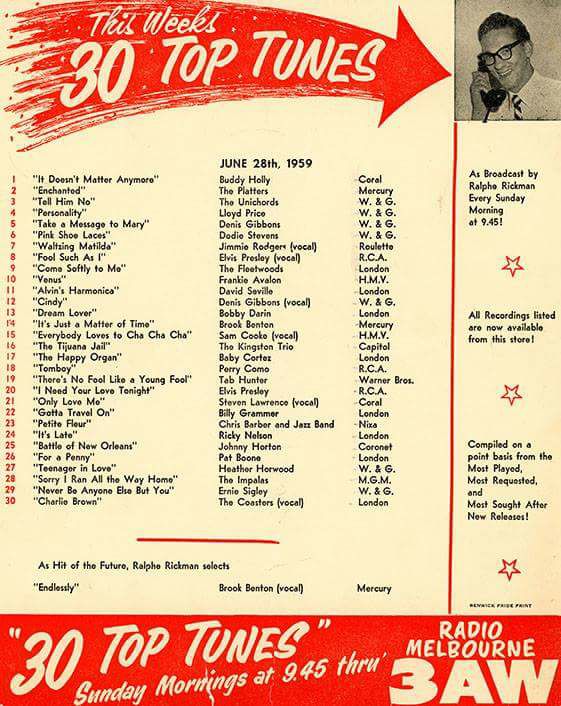
For Melbourne station 3AW in 1959 the chart was compiled on a point basis from the most played, most requested, and most sought after new releases. ("Most sought after" sounds especially rubbery. See also my blogpost 3AW creates a chart.)

It's not uncommon to find a song that charted at one station but not at another in the same city. 

As chart collector and compiler Tom Guest puts it, At times 'hits' were played on one radio station only and thus appeared on their own charts and not on those produced by stations who, for various reasons, did not include the songs on their airplay lists.

Sales figures and radio charts Sales figures were based on samples rather than comprehensive data from every outlet in town. Wayne Mac, in his radio history Don't Touch That Dial, writes: To compile the 40 most popular songs, stations telephoned selected record stores in their area which reported sales figures on records and sheet music. In addition to raw sales figures, the position or ranking of the week's 40 most popular songs was also subject to overseas sales trends and a station's own predictions ...

I don't believe the collection of sales data was always a rigorous process. The ring-arounds to local record stores could be as informal as asking what was selling. One of my reliable correspondents, who worked at a capital city record store, says that it depended on whoever happened to answer the phone, as it wasn't unusual for that person to boost their favourite records.

Retrospective charts can disagree The job of the latter-day chart compiler is to apply some kind of statistical method to reconcile the differences and come up with plausible charts for a city. 

At my website I use Gavin Ryan's charts for Sydney, Melbourne, Brisbane, Adelaide and Perth. For two cities there are alternatives: Tom Guest's Melbourne chart book (Thirty Years of Hits) and Top 40 Research's chart book for Sydney (The Book).

This could be confusing to a casual reader. If Gavin Ryan's Sydney chart book has The Rolling Stones' The Last Time peaking at #1 in April 1965, that's it, isn't it? Either The Last Time was #1 in Sydney or it wasn't. So how is it that the other Sydney chart book, The Book, has it peaking at #2

Sometimes the contrast is greater: down in Melbourne, Gavin Ryan has The Ray Price Quartet's A Moi De Payer (1962) at #6, Tom Guest has it at #24.

Clearly, these differences are partly down to differences in statistical methods. I'm not privy to these, but Tom Guest told me that he weighted his placings in favour of 3UZ, the highest rating Top 40 station in Melbourne during the 60s, something that makes good sense to me. Even so, Tom has The Groove's Simon Says peaking at #6, and it's Gavin who has it spot on the 3UZ peak at #4. (Add 3DB's #8 to the list and you have three different peaks for the song.)

Another variable is the availability of historic charts to each compiler. Some of them can be found in newspaper and magazine archives, but otherwise it depends on chart collectors. The compilers I know of started out as collectors, but there can be gaps in the charts they can access. Gavin Ryan lists his sources in each book, with a note to the reader: If anyone has further charts that are not listed above, I would be most appreciative if you could pass them on to me for future updates of this book.

Comparing radio charts In spite of these variables, and the presence of outliers in many charts, popular songs could follow similar trajectories in and out of competing station charts.

As one example, I looked at the chart history of an Australian record from 1967, Simon Says by The Groove, as it charted at 3UZ and 3DB in Melbourne. (Chart site ARSA has an uninterrupted run of charts from these two.) It shows up how the charts could differ from each other in detail, but it also shows how close they could be.

Simon Says was on the charts from September 1967 to January 1968. It did better on 3UZ than on 3DB.

3UZ: 18 weeks on the Top 40, 4 weeks in the Top 10, peaked at #4.
3DB: 16 weeks on the Top 40, 2 weeks in the Top 10, peaked at #8.

National charts Even the standard national Australian charts for these early decades, now published by David Kent, are based on radio surveys. As he puts it at his website, before rock'n'roll and in the earliest Top 40s, Hit Parade lists were compiled from sales of sheet music as well as records, plus other factors such as public requests and (perhaps) the opinions of radio stations’ personnel!

David Kent's own Kent Music Report provided the de facto official national charts from 1974 till 1983 when ARIA started its charts. Even then, Kent's data, which had increasingly emphasised sales figures over radio surveys, was licensed to ARIA until 1988. 

Go-Set's national charts An earlier national Top 40 had been published in Go-Set magazine 1966-1974 (now published online at gosetcharts.com). It was compiled by Ed Nimmervol using, according to chart historian Daniel Lowe, a combination of sales figures from retail stores as well as... data from the radio stations charts from around the country

Even so, in 1968 (for example) the Go-Set carts were simply headed with This chart is calculated each week from the most recent charts from the following radio stations: 2UW, 2UE, 3UZ, 3AK, 3DB, 3XY, 4BC, 4IP, 5AD, 6KA, 6PR, 6KY, 7LA, 7HO

(The earliest charts in Britain were also compiled by music magazines. The New Zealand Listener magazine's charts 1966-75initially based on reader polls, are often cited as the de facto NZ charts for that time.)

What should we make of all this? So if the retrospective charts we have now are not strictly a reflection of how well records actually sold back in the day, but seem to be based on sources that were open to all sorts of biases, are they a pointless exercise? If #10 in 1967 doesn't necessarily mean #10 as we understand it from say, the modern ARIA charts, am I wasting my readers' time by including chart positions at all?

Well, no. And no. It's possible to be too cynical about these collections of playlists, selective sales figures, and whatever the radio stations wanted to type into their charts. 

Even if they were nothing more than a collection of radio playlists, they would provide a pretty good snapshot of what we were listening to at the time.

At the website of pirate station Radio London (The Big L), the compilers of the Fab 40 charts understand this. Not only are they explicit about the fact that the Big L charts were never compiled from figures supplied by retailers, but they consider this to be an advantage: These Radio London Fab Forty charts differ very much from the National or 'Official' sales-based charts of the time, in that they contain numerous entries from obscure recording artists. Those quotes around 'Official' almost look like a put-down.

In the 50s and 60s, we listened to radio. There was no Spotify or YouTube, no instant downloads or file sharing. There was radio, some TV, and some vinyl if you could afford it (I usually couldn't: most of my 45s were oddities from the cut-out bins). But mainly it was radio. Our generation had a transistor radio to an ear at every possible moment. We woke up to Top 40 radio and we fell asleep to it.

Listening in to Melbourne, I was a dial surfer, from The Greater 3UZ, over to 3DB for Barry Ferber, and on to 3AK or 3KZ as the whim took me. I became a fan of 3XY when it flipped to a pop format.

As a result, if I browse through the Melbourne chart books of Gavin Ryan or Tom Guest, compiled using charts from several stations, I am looking at a recognisable analogue of my teenage listening experience and, I assume, that of my readers. 

Remember too, that radio stations were in a competitive commercial industry. It was their job to tap into the tastes and preferences of their audiences, and I doubt that their playlists and charts were compiled offhandedly. A retrospective chart based around radio playlists still has credibility, even if its sources were not based strictly on sales data.

A final digression My habit of switching stations must have been common, because when 3XY changed its format from adult-oriented albums to Top 40 singles, it placed its news at 10 to and 10 past the hour, an innovation from America. The thinking was that kids listening to the established stations would twiddle the dial in search of music when the news came on at the top of the hour. At that time 3XY would be playing a record, so the kids might discover the station and stay... But maybe only till 10 past when the news came on! 

Related My post about historical New Zealand charts Introducing the N.Z. Hit Parade! (March 1966).


Toppermost of the poppermost are John Lennon's words, but you probably know that by now.

Sources I haven't used academic footnoting, but I've drawn on these sources.
Daniel Lowe's informed, concise overview of the history of Australian charts. [Offline but archived here.]
Detailed chart history at Milesago which covers Australia and other countries: Top 40 Radio and the Pop Charts
• The indispensable ARSA - The Airheads Radio Survey Archive
• Wayne Mac, Don't Touch That Dial: Hits & Memories of Australian Radio (2005)
• Gavin Ryan's Music Chart Books for Sydney, Melbourne, Brisbane, Adelaide and Perth 1953-2013, (2004-2007)
• Thomas J. Guest, Thirty Years of Hits: Melbourne Top 40 Research 1960-1990 (1991)
• Jim Barnes, Fred Dyer and Stephen Scanes, The Book, Top 40 Research Services (1986)
Website for David Kent's Australian Chart Books (includes online store)
• Alan Smith's history of British charts at Dave McAleer's website [Internet Archive]
• New Zealand's Lever Hit Parades 1960-66 and NZ Listener Charts 1966-74 with brief commentary at Flavour of New Zealand.


Collectors' Corner Here is my entire collection of authentic 1960s charts

:

24 October 2020

▶︎ Bigger in Oz (14): Diana Trask - Oh Boy (1974)

Bigger in Oz: tracks that were more popular in Australia than in their countries of origin.

See also: Only in Melbourne.

 
14. Diana Trask - Oh Boy
(Tony Romeo)
USA 1974

ABC Dot single (USA) # DOA-17536
Dot single (Australia 1975) K-5808

US pop charts: Did not chart Top 100
US country singles chart (Billboard) #21
Australian charts: #2 Melbourne, #4 Sydney, #2 Adelaide, #7 Perth (#10 Australia)

Back at the website I have written about Going SteadyDiana Trask's first single, released in Australia in 1958. 

See also Bigger in Oz (20): Diana Trask  - Long Ago Last Summer (1960)

Oh Boy is an American record by an Australian singer. It was produced in Nashville by Jim Foglesong, the distinguished country music producer, A&R man, and recording industry executive. 

By the time Oh Boy was released, Diana Trask was living and working in Nashville, where she was following a successful career as a country singer. The single didn't chart on the American pop charts, but it did better on country music charts. On Cash Box's Country Top 75, for example, it reached #16 in March 1975.

Trask (b.1940) began her career in the late 50s in Melbourne but she soon moved to the US, in 1959. Before too long she was a regular on the high-rating network TV show Sing Along With Mitch. YouTube

There are parallels with Helen Reddy, another young single woman from Melbourne who successfully tried her luck in the US. She was born only a year after Trask but moved to the US later, in 1966.  

Diana Trask supported Frank Sinatra on an Australian tour in 1959. He encouraged her move to the US, and later that year he took an entourage of dinner guests to her New York opening at the Blue Angel.

_________________________ 

Oh Boy is an original song written by Tony Romeo. (The 1957 Crickets hit is a different song.) To my non-musicologist's ear, it seems to be an inventive composition with multiple melodic ideas, unusual in a popular song.

It was later recorded in Britain by Brotherhood Of Man as Oh Boy (The Mood I'm In), with an arrangement by Tony Heller (1977, #8 UK). YouTube

Tony Romeo (1938-1995) was a prolific songwriter. Wikipedia lists around 130 compositions, mainly from the mid-60s to the late-70s, and 45cat has numerous entries for Tony Romeo - composer. He was also an arranger, producer, and performer.

You might be familiar with these Tony Romeo compositions:

Other notable artists who recorded his songs include David Cassidy, Wayne Newton, The Everly Brothers, Paul Anka, and Richard Harris. As a producer he worked, for example, with Richard Harris (Slides, 1972) and with Lou Christie (Lou Christie, 1974).  

As a performer, he recorded a couple of solo singles. (I've seen a self-titled album mentioned but I can't verify it.) With Cassandra Morgan and Frank Romeo - his brother - he recorded as The Trout for a well-received 1968 album, The Trout, produced and written by Tony. YouTube

_____________

Update (thanks to Triman, via the Comments): In the mid-70s Tony Romeo worked for the Three Brothers label, set up by jazz producer Creed Taylor. The label's discography consists pretty much of some singles by Lou Christie, and a self-titled Lou Christie album (1974, the only LP on the label until two outliers, in 1983 and 1994). Romeo was heavily involved, as writer, arranger, producer and musician. Also contributing were Cass Morgan and Frank Romeo who had been in The Trout with Tony in the late 60s. Mark Cathcart tells the full story in detail at his fan website Creed Taylor Produced.

29 May 2020

▶︎ By the way, what is yéyé?

Philippe Edouard, PopArchives correspondent in France, traces the origins and aftermath of yéyé. 
 
"French yéyé is the best music in the world."

This assessment by the Californian singer-songwriter April March is very flattering to French pop, but it may be exaggerated.

But by the way, what is yéyé?

The expression indicates a musical style that appeared in France at the beginning of the Sixties, influenced by the Anglo-Saxon pop successes of this period. Nowadays it is even applied to the whole decade of the Sixties, without distinction among musical genres.

Saturday June 22, 1963: Radio Europe1 organises what would be known as La Folle Nuit de la Nation (mad night at the Nation), a free outdoor concert of rock and twist at Place de la Nation in Paris, performed by the idols of the moment.
Europe1 hopes to bring together 20,000 young people, but there will be 150,000 teenagers. Some speak of 200,000 fans.

The next day, the government and the press are terrified. Journalists report the damage caused by the "Blousons Noirs" (hooligans, lit. "black jackets"). The organisation, the singers, and the fans all go down in flames. The event is so phenomenal that the press around the world begins to talk about it.

 
 On July 6, 1963, the sociologist Edgar Morin publishes an article on this phenomenon, in the newspaper Le Monde. He intelligently describes the ongoing changes in youth.
For the first time the word yéyé appears in the press.

Edgar Morin is therefore seen to this day as the father of the word yéyé. Now 98 years old, he always takes pleasure in talking about his creation and nobody finds anything to complain about, except certain musicologists. Did he find it in a flash of genius? False! He visited the haunts of young people, including the famous music club Golf-Drouot in Paris.

The band Long Chris et Les Daltons are regulars at Golf. Their guitarist, Jean-Pierre Bordi, alias Peter, who spends his life there, does not stop to finish his sentences when he enthuses about it: "It's yeah, yeah..!”

(The group's rhythm guitarist Gérard François, aka “Wimpy”, says yer, yer for yeah, yeah, and so is nicknamed Yer Yer.)

In this way the interjection yé-yé was born, not spontaneously, but in the confines of Golf Drouot where the expression became part of everyday life. And the yeah! yeah! that we often hear in Anglo-Saxon rock songs is adopted by their French counterparts.

On disc, Georges Aber used it for the first time in early 1963 with ‘Des ya ya des yé yé’. However, up until mid-1963, the singers of the 60s were called simply rockers or twisters or even copains (buddies) and idoles (idols).

With the advent of the twist, the recording industry had organized itself and quickly recovered from the surge of rock.

In 1962 Claude François and Sheila, the prototype yéyé artists, appear. They sing of the twist, but also of the new trends like the hully-gully, mashed-potatoes, and Madison. It is a variété rythmée (pop music) that appeals to young people and reassures parents. Record labels promote many idols who, for one or more EPs, will discover glory in a more or less ephemeral way.

1963 marks the start of the British invasion. Rock singers and French British-beat groups have a hard time being heard, unlike during the first wave of rock and twist. Besides, the rockers are pure and hard, so there is no question of them going yéyé. It is marshmallow, a less virile form of their music, worked over by showbiz.

1966 comes around. The older generation was used to being more or less contemptuous or indifferent to yéyé.

Suddenly they are shaken by a newcomer. Antoine, with an air of folk-rock tinged with the jerk, throws everything out the window, finding his generation as old-fashioned as the old. His song Les élucubrations d'Antoine [YouTube] revolutionizes French music but also shakes up society. Talking about over-the-counter contraceptive pills in supermarkets was totally subversive at the time.

Jacques Dutronc and Michel Polnareff also disrupt the music with original lyrics that no longer speak only of love affairs but of a society of consumerism and sex. Girls are not to be outdone: Charlotte Leslie clearly says: "Girls, they are made for making love" [YouTube]

 
This moral revolution lands two years before the May 1968 student revolt which will lead to huge strikes and radical changes in society.

Strictly speaking, yéyé is of the period between 1963 and 1966. It could go back to mid-1962, but the name does not officially exist. And it could continue after 1966, but the term becomes more and more overused.

This musical phenomenon shines in the French-speaking world - Belgium, Switzerland, Luxembourg and Quebec - but also in Italy, Portugal, Lebanon, and even in Japan. Its influence is also felt in South America.

The other country of yéyé (as with the EP) is Spain, which will reproduce in its own way the French wave. [YouTube]

In 2013, in England, the music journalist, author, singer, and publisher Jean-Emmanuel Deluxe published compilation albums and a book of French pop singers from the 60s. He called this series 'Yé-Yé Girls'. Since then, the name has toured the world. He can be reproached for being a bit of a copycat, but thanks to him everything is finally official. Since then, other yéyé collections have appeared in Anglo-Saxon markets.

By the way, how is it written? Yé-yé or yéyé? Or yeyé as in Spain, or even yèyè as in Italy? Do you need a plural “s”?

Originally, yé-yé is a double interjection so we put in the hyphen. Interjections do not take a plural. Thereafter the attached form yéyé becomes plural, yéyés. But whatever the spelling, it remains an emblem of freedom for the youth of the 60s.

Philippe.
____________________________

Further reading, viewing:

Christian Eudeline, Anti Yéyé (2006)
Remarkable work on singers and beat groups who had a difficult career because of yéyé and the British Invasion. (In French. The title is inspired by Pierre Vassiliu's 1963 song Twist Anti-Yé.)

YéYé Révolution 1962-1966
(2010)
TV documentary (in French) at YouTube. A visual and musical treat, featuring many key figures of the period including Sheila, Claude François, Sylvie Vartan, Dick Rivers, Francoise Hardy, and Johnny Hallyday.
____________________________

Update 2022:
Newly published and well-reviewed, this will be followed by a second volume up to the late 1960s. The author is a friend of PopArchives who is credited in several places for his contributions.
____________________________

06 May 2016

▶︎ Eulogies and celebrities (from 'Friday on My Mind')

I wrote this post as a guest at Bob Wilson's weekly blog Friday on My Mind 

---

6 May 2016 Back in January, when Bob and I discussed how lavishly some musicians are eulogised, it was David Bowie’s death that was in the news. Then Prince died a couple of weeks ago and my Facebook timeline filled up with posts from shocked friends. Still trying to digest this, said one, I just… I just can’t believe it said another.

There were Prince videos, and mentions of purple rain, Paisley Park and raspberry berets. A few days later, a friend said he had been listening solidly to Prince’s music for the past few days. Even literary magazine The Paris Review posted twice about Prince to Facebook. When my digital copy of  The New Yorker  appeared during the week, its cover was given over to a simple depiction of… purple rain. At the weekend, somebody at our monthly book club meeting repeated the (unfounded) gossip about Prince having had AIDS.

The Sydney Morning Herald reported that Prince was soaring to the top of the album charts as mourning fans rush to remember the artist’s legacy through his music. This sounded like clumsy reporting. A fan doesn’t wait for the artist to die, they go ahead and access the music whenever it’s available, and in any case there didn’t seem to be a need for anyone to rush. A dignified saunter, perhaps.

As Bob said in his post following Bowie’s death, “some will grieve, others are just sad,” and on that occasion I was in the sad group, but I couldn’t say I was grieving. I remembered individual songs with affection, but the bottom didn’t fall out of my world.

In the case of Prince, I was on the footpath, watching the wild and colourful funeral procession of a stranger passing by. Many had urged Prince’s music on me over the years, and I had often followed their advice and listened, but I never became a fan. My response wasn’t callous, this was the death of a man of 57, too young in any walk of life, but I wasn’t shocked and I can’t say I was grieving.

The extent of the reaction took me by surprise, but as an outsider I’m not qualified to belittle it. No doubt there were outside observers who didn’t get it when we mourned the deaths of Buddy Holly and John Lennon, two examples when I was an insider and did get it.

Jack Shafer at Politico, wrote about the “mega-obituary” and suggested that Prince died when his prime fanbase, “Prince-loving Boomers and Gen-Xers”, are in a position to call the “editorial shots”. In The Guardian, Ian Jack commented tetchily on the voluminous David Bowie tributes, including 24 pages in The Guardian. He went to that paper’s archives and discovered its muted reporting of the deaths of Buddy Holly and Elvis Presley, a contrast that seems to support Shafer’s point.

Regardless of generational bias, I’ve never understood the impulse to go out and buy – or stay in and download – the works of an artist who has just died. If anything, my impulse has been to give their works a rest for a while. Later, I get back to them with the old enthusiasm.

No doubt, there are a lot of people who discover the artist through the publicity around their death; they like what they hear, and go ahead and buy some of it.

It is remarkable how people can genuinely grieve for a celebrity they’ve never met (Amy Winehouse, Whitney Houston or B.B King). We are routinely saddened, even depressed, about the deaths of unknown people we’ve never met, victims of violence or epidemics. But the grief some people show for celebrities goes beyond that natural empathy for another human. When Steve Irwin died, the circumstances were shocking, and it was a wrench to see such a positive, larger-than-life figure suddenly taken. A teaching colleague and her students made tributes which she delivered to Australia Zoo. They clearly felt that they knew Steve as if he had been present, in person, in their lives. I read an online comment from a woman who said her three-year-old already missed Steve, a sentiment you often see: they miss the celebrity.

I can think of times when I’ve missed a celebrity. I still miss Jon Stewart (still alive, I hasten to add) hosting  The Daily Show, because I used to enjoy watching him every day, and now I can’t do that. When Phil Hartman died in violent circumstances it was shocking, and I missed him when he was no longer in the next season of Newsradio, but his absence was in the nature of a cast change, not in the sense that I was used to having him around the place and then he was gone. I was a little sad and reflective when Groucho Marx died, but I couldn’t really say I missed him. I didn’t come down to breakfast and think, “Gee I miss seeing old Groucho there every morning, cracking his egg open and making wise-ass comments over the morning newspaper.”

There is a persistent illusion that we “know” an artist through their work. Of course we know that important aspect of them, but we don’t know them as we know people we see every day. I’m not convinced that we can confidently claim to know a person through their works, in spite of attempts by some scholars of Shakespeare or J.S. Bach to extrapolate biographical details from the works. This is partly because a work of art has a life of its own that is beyond the control of its creator, especially after it’s published and every member of the audience puts their own construction on it.

Note the surprise when well-loved celebrities disgrace themselves. Bill Cosby? Surely not! We know him so well, it’s not possible. Rolf Harris? Nooo, not Rolf! Please! tweeted the twitterers. We forget that we know only their published work, a little gossip and second-hand reportage, and a carefully crafted public persona that may tell us nothing about them out of the public gaze. Forgetting that, it’s a small step to grieving for them as if we’ve lost a family member or close friend.

I wondered why the cause of Prince’s death was so important to the fans. Then I thought of an example of my own. I’m a fan of British singer-songwriter Nick Drake who died in 1974 aged 26 without achieving much recognition. By the 1990s, when I discovered his albums, musicians were citing him as an influence, his songs were being heard in films, and he was being championed by MOJO magazine.

Even long after the events, I read everything I could, and hung out for the bio-doco A Skin Too Few, made by his sister Gabrielle who disagreed with the coroner’s suicide finding. I was interested in a theory that his depression was down to the grey English winters, a known syndrome. I was fascinated by a video snippet of a young man walking away from the camera at a music festival, in what might or might not be the only existing footage of Nick Drake.

See how they weave a spell on us, when we connect with their work?

All in all, though, a minimalist approach would suit me. Report the news succinctly and without gushing, write a well-researched obituary, and leave the rest to the reader. My ideals are those concise obits in the British press that manage to cover the life and achievements of an artist in one page. As a bonus, they usually get the details right and don’t demand any mass emotional response.