Music and sidetracks of the 50s, 60s and 70s, more or less related, or not, to my Australian song history site "WHERE DID THEY GET THAT SONG?" at POPARCHIVES.COM.AU
The latest from my website's front page series about lesser known artists who performed the original versions of Australian or NZ records.
See also: the full collection of over 40 Obscure Originators features.
____________________
Love - Hate - Revenge (1968, #2 NZ) was the highest charting of five Top 10 singles for The Avengers. They could be confused with numerous other Avengersall over the world,
but this was a Wellington band, another of those popular New Zealand
bands that were unknown to most Australians. Our loss, clearly.
The original version, Love, Hate, Revenge (If I Want You To Cry) (1967), was by The Del Satins, a New York doo wop group who were heard by millions but not so well-known by name.
Anyone familiar with Dion'srun of successful solo records in the early 60s has heard The Del Satins. They were his regular backing singers, uncredited on songs like The Wanderer or Ruby Baby.
That's The Del Satins you hear behind Dion, repeating the doo wop line that is essential to his #1 hit Runaround Sue (1961). There are varying transcriptions, but this sheet music shows Hayp, hayp, bum-da hady hady ...
Doo Wop Biographies & Discographies pointedly states that The Del Satins received no credit on any of their 13 hit records. That reliable source also rates them as one of the finest white male doo wop groups of all time.
None of The Del Satins' own ten singles 1961-67 charted Top 100 USA, although Feelin' No Pain (1963) made Billboard's
Breakout chart as a regional hit in New York. They would later become
regulars on Cole Clay's weekly TV music show, aired locally in New York.
In 1968, with two original members and recent recruitJohnny Maestroin the line-up, The Del Satins merged with Rhythm Method to form a new band called Brooklyn Bridge, led by Maestro. They had a hit with Worst That Could Happen (1968 #3 USA), written by Jimmy Webb.
Bigger in Oz: tracks that were more popular in Australia than in their countries of origin. See also: Only in Melbourne.
These are two different songs called Hawaii,
both recorded by popular American artists.1 They charted Top 10 in Australia within a few months of each other in 1964 but did not chart in the USA.
22. The Beach Boys - Hawaii (Brian Wilson) USA 1963 Capitol album Surfer Girl (USA) ST-1981September 1963 Columbia single (Australia only) CP-1551January 1964
Australian charts: #2 Sydney, #5 Melbourne, #1 Brisbane, #7 Adelaide | #9 Australia US charts: Not released as a single
23. Gene Pitney - Hawaii (Al Kooper - Bob Brass - Irwin Levine) USA 1964 Musicor single#MU 1040July 1964 United Artists single (Australia) UA 1059August 1964 (entered charts)
Australian charts: #8 Sydney, #5 Brisbane, #7 Adelaide | #6 Australia. Co-charted with the A-side It Hurts To Be In Love which was a hit in all capital cities. US charts: The A-side was a Top 10 hit but Hawaii did not chart in its own right.
_______________________
22. The Beach Boys - Hawaii
Written by The Beach Boys' Brian Wilson, Hawaii was an album track in the USA, but it became the A-side of a single in Australia and, as far as I can see, nowhere else.
That is not surprising. Hawaii is a surf song, and by January 1964,when the single was released here, Australia had a thriving surf music industry of its own. This is a country with a strong beach culture, and you didn't have to be a surfie to like the music.
It was also the summer of Beatlemania, and the British Invasion was under way. At Sydney radio station 2SM, Beatles records were at #1, #2 and #6, and there were already otherBritish Invasion bands on the chart. Teen idols were shampooing out their hair
oil, instrumental bands were recruiting singers, and the surf era was about to fade.
On the 17 January 1964 Top 100 chart from 2SM,2 the 50 highest charting records included: 7 British bands(9 records, 18%) 9 Australian singles (18%) all beach- or surf-themed 8 original Australian compositions.
Nine months later, on the chart for 16 October 1964, the surf craze had passed, leaving only Jan & Dean'sRide The Wild Surf along with The Hondels'Little Honda and Ronnie and the Daytonas' G.T.O. from a surf sub-genre about vehicles that had been around as long ago as The Beach Boys' 409 (1962).
16 October's highest 50 tracks at 2SM included: 11 British bands3 (15 records, 30%) 2Australian singles4 (4%) no surf 1 original Australian composition.
By October, even the Beach Boys had moved on from the sun, sand and surfing of Hawaii (and California). They appear at #57 on the 16 October chart with When I Grow Up (To Be A Man). Its reflective lyrics and innovative arrangement hinted at their further development. Far from being set back by the British Invasion, theiralbum Pet Sounds (1966), partly inspired by The Beatles'Rubber Soul (1965), would in turn be acknowledged as an influence on The Beatles'Sgt Peppers' Lonely Hearts Band (1967).
Footnotes 1. Hawaii by Jan & Dean (1967) is another different, non-charting song, written byJan Berry andJill Gibson. (Merci à Philippe.) 2. I have reservations about radio station surveys, but I use 2SM's chart as a reflection of what this prominent pop station would have been playing. And a good source of its Top 100 charts is available atrateyourmusic.com. 3. Even though they were not a British Invasion band, I counted The Shadows for being British. 4. There were two New Zealand records in the top 50: Ray Columbus & The Invaders - She's A Mod (#3) and Dinah Lee - Don't You Know Yockomo (#49)
23. Gene Pitney - Hawaii
This is not a surf song, rather a romantic picture postcard about an emotional parting under the moonlight on O'ahu Bay: Love is right here in Hawaii, Must it end with a tear in Hawaii?
Gene Pitney released so many excellent and varied records that the ones you remember might depend on where you lived. I have previously posted about Billy You're My Friend (1968), popular in Melbourne, Adelaide, Brisbane and Perth, but not in Sydney, the US or Britain; and Mecca (1963), which charted #12 USA and #7 Australia but didn't make the Top 75 in Britain.
Hawaii was the B-side of Pitney'shit It Hurts To Be In Love. In Australia, both sides charted in Sydney, Brisbane and Adelaide, but the A-side alone was a hit in Melbourne, Perth, the US, and Britain.
This happened with Who Needs It (1964), a B-side that charted Top 10 in Australia. It had been forgotten by Pitney when he noticed Australian audiences calling out, 'Who needs it?' and realised they weren't heckling him but were requesting the song.
For background on Hawaii, including its writers Al Kooper, Bob Brass and Irwin Levine, the best place is the detailed page on the song by Ray McGinnis at his Vancouver pop hitswebsite. Hawaii comes in at #9 Vancouver, and I am impressed by Ray's thoroughness in mentioning the song's #8 Sydney.
_______________________
Australian chart sources for this post: 2SM Top 100: Lists at rateyourmusic.com by Badgerdarkness and collaborators. Capital cities: Gavin Ryan's chart books. Australia: Grant Dawe's Top 100 Singles site.
The latest from my website's front page series about lesser known artists who performed the original versions of Australian or NZ records.
See also: the full collection of over 40 Obscure Originators features.
____________________
Australian singer-songwriter Gary Shearston became known in 1974 for his laid-back, guitar-strumming update of Cole Porter's I Get A Kick Out Of You, recorded in London ( #7 UK #19 Australia).
Nine years earlier, he had emerged from Sydney's folk scene and onto the radio with Sydney Town (1965),
a topical song full of droll comments on Australian culture and
politics. It charted modestly, in Sydney and Brisbane only, but I heard
it often enough on Melbourne radio for it to have become familiar.
The writers of Sydney Town areShearston with Frank Hardy, the Australian writer, activist, cartoonist and yarn-spinner whose major work is his novel Power Without Glory (1950). The sheet music credits words by Frank Hardy; additional words and music by Gary Shearston, as in the US copyright.
Hardy wrote the lyrics first then shared them with Shearston who worked them up further with whimsical references like Rinso: keep Australia white,
linking White Australia immigration policies with a laundry detergent.
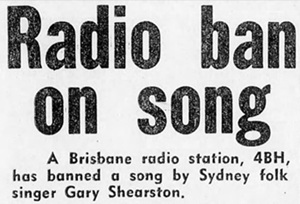
That particular quip helped to get the song banned from Brisbane radio
station 4BH.
According to the liner notes toShearston's 1965 album Australian Broadside, a friend of Hardyhad given him a recording by a "calypso singer" of a song about the slums of Kingston town, the capital of Jamaica, andHardy rewrote those lyrics for Sydney Town.
As an origin story for a song, this is unsatisfying. The liner notes, by academic and Shearston mentor Dr Edgar Waters, tell us nothing about the "calypso singer" or the original song, or its composer.
Nothing is clear. The word "recording" is ambiguous, as it could mean
a released record or a private tape recording, and the song could have
been an obscurity, orally transmitted with no known composer.
The trails have no doubt run cold, but I have been unable to find
anything more about a calypso song, on or off record, that may or may
not have been called Kingston Town. All in all, I'm inclined to treat the evidence for it as anecdotal.
And I can't help thinking about Frank Hardy, winner
of Australia's 1967 Yarn Spinning Championship with 22 tall stories.
Could he have been pulling someone's leg about a calypso singer and a
song about Kingston, Jamaica?
From my website's front page series about lesser known artists who performed the original versions of Australian or NZ records.
See also: the full collection of over 40 Obscure Originators features.
____________________
You Make Me Happy (1964) charted Top 20 in Sydney and Brisbane for that versatile entertainer and TV star Jimmy Hannan. So, a moderate hit but a good example of Australian diligence in finding material for cover versions.
The original was by Val Martinez, a B-side on RCA Victor (1963, wr. Jimmy Curtiss). He recorded four singles (1962-63) for RCA at its Hollywood studios with some of LA's top session musicians.
Martinez's RCA records have been well-reviewed,
sometimes in retrospect (alas!). They have been taken up by some
Northern Soul enthusiasts and dealers (again, too late!), and although
that term is carelessly thrown about, it's not nothing.
Martinezwas not a prolific recording artist. Apart
from the four RCA singles, he had released four previous singles on
three other labels, beginning with two on Cincinatti's King Records back
in 1954. That appears to be the extent of his discography, but he was a
well-booked club singer in Las Vegas and Hollywood and I'm guessing
record sales were never his bread and butter.
____________________
In the 1920s and 30s another Val Martinez released many Spanish-language records and performed daily on Mexican border station XER.
He was the father (1900-1943) of You Make Me Happy originator Val Martinez (1936-1998), and grandfather of the present-dayVal Martinez who was once in a Four Seasons revival withFrankie Valli and now provides events and tuition through Val Martinez Music in Southern California.
I understand that the family tree goes back to yet another musical Val Martinez, the great-grandfather of the current Val Martinez, but that was beyond the reach of my research.
____________________
The Australians weren't the only ones to spot the potential of You Make Me Happy. AfterJimmy Hannan'srelease in March 1964, at least three versions of the song came out in other countries later in the year, including one byBruce Channel in the style of his hit Hey! Baby.
From my website's front page series about lesser known artists who performed the original versions of Australian or NZ records.
See also: the full collection of over 40 Obscure Originators features.
____________________
Gee I’m Gonna Miss You (1968) was one of seven Australian singles released 1966-1971 by British-born Brisbane singer Graham Chapman. It topped the charts in Brisbane and made the Top 20 in Melbourne.
Christchurch singer Marc Antony (stage name of Pat Kearns) released a further version in New Zealand (1969).
The original version was by The Improper Bostonians (1967). It was one of four singles they released 1966-67 on Minuteman, a small Boston label that was a subsidiary of a local entity called Columbus Records. It was also issued nationally on Coral, but it seems not to have done much business anywhere, on either label.
The Improper Bostonians were a quartet from Lynn in Greater Boston who had a residency at the Ebb Tide, a nightclub in nearby Revere Beach.
Gee I'm Gonna Miss You was produced by Minuteman's owner Bill Walsh with Barry Richards, vice president of Minuteman and Walsh's co-producer on five of the eight Improper Bostonians tracks. It was written by Walsh too, with Joe Ahern, his collaborator on four of the band's six original tracks.Ahern still has five compositions registered at BMI under his full name Thomas J. Ahern (spelt Ahearn on the Coral single) but details are elusive.
The band's name would have been recognizable in Boston from Proper Bostonians, meaning the well-established upper-crust families of Boston, also known as Boston Brahmins (at Wikipedia, for example). There was even a book, The Proper Bostonians (1947), which explains, "Everywhere the Proper Bostonian goes in his city he is likely to find that the magic of the Family Name pronounced will open virtually all doors ..."
As forImproper Bostonians, that was probably an inevitable coinage, used whimsically or when reporting unruly behaviour from Bostonians. There was an Improper Bostonian room at Boston restaurant Your Father's Mustache in the 1960s, and a Boston lifestyle magazine The Improper Bostonian (1991-2019). Newspapers have used improper Bostonians when reporting on boisterous Red Sox supporters and over-enthusiastic fans of movie star Elizabeth Taylor.
From my website's front page series about lesser known artists who performed the original versions of Australian or NZ records.
See also: the full collection of over 40 Obscure Originators features.
____________________
Of Hopes And Dreams And Tombstones was covered by The Purple Hearts, a respected Australian band with R&B-blues influences. It charted in Melbourne and Brisbane in 1966.
Australian listeners might have been surprised to learn that the original version was recorded as part of a 1965 US government campaign. The aim was to encourage teenagers to stay in school, unlike the singer who is working three jobs a day and regrets quitting school too early.
The Youth Opportunity Back-to-School Campaign distributed the single free to American radio stations with a formal message on the sleeve from Vice President Hubert H. Humphrey.
In spite of its origin, the record is a convincing piece of mid-60s popular music that was later adopted by Britain's Northern Soul movement. The vocals and the harmonica-led backing make it sound like a perfectly credible (even groovy!) rock record of the time.
The title of the project is printed on the label instead of an artist's name, so the singer goes uncredited. He was Jimmy Fraser, still a mystery although I have seen it suggested that this was a pseudonym. Columbia Records did reissue the track commercially as aJimmy Fraser single, but that was the last we heard of him, at least under that name.
Credit for the song's credibility goes also to the composer, Joy Byers. She wrote,for example, Eddie Cochran’s C’mon Everybody, several songs for Elvis Presley and (with co-writer Clyde Otis) Timi Yuro's What's A Matter Baby (Is It Hurting You).
In 2002 The Purple Hearts'Australian version provided the opening track and the title of one of Alex Palao'sexcellent Ace Records (UK) compilations, Of Hopes & Dreams & Tombstones (Beat 'n' R&B From Down Under). For me, that just about confirms the song's groovy status.
Singing star of the 50s Teresa Brewer's voice was familiar on radio and records throughout the 1950s. From 1950 to 1957 she made the Top 40 twenty-five times, beginning with Music, Music, Music(1950, #1 USA), also known for its familiar opening words Put another nickel in, in the nickelodeon.
Some of her songs, like Ricochet (1953, #2 USA), were in that perky post-WW2, pre-rock'n'roll vein of Music, Music, Music, but that did not confine her.
A Tear Fell (1956 #5 USA) was on the pop charts while Ivory Joe Hunter's version was charting #15 R&B, and her cover of Sam Cooke's current hit You Send Me charted #8 USA for her in 1957.
In the following years she proved her versatility by recording albums with jazz greats including Count Basie (The Songs Of Bessie Smith), Stephane Grappelli and Duke Ellington. On the 1973 album In London she recorded contemporary songs with Oily Rags, a younger band featuring Chas Hodges and Dave Peacock, soon to be stars as Chas And Dave.
_________________________________
Teresa's versions of Australian hits She clearly cast widely for material. Her cover versions even included three songs previously released by Australasian artists, songs that were familiar in Australia.
There were Teresa Brewer versions of:
•Col Joye'sBye Bye Baby (1959, #1 Sydney #3 Melbourne #2 Brisbane #2 Adelaide #2 Perth; #3 Australia). Covered on 1959 single usingthe alternative title Bye Bye Baby Goodbye.
•Patsy Ann Noble'sGood Looking Boy(1961, #16 Sydney #6 Melbourne #13 Brisbane #8 Adelaide; #17 Australia). Covered on 1961 single, song retitled Pretty Lookin’ Boy.
•Maria Dallas'sAmbush (1967, #19 Sydney #12 Melbourne #4 Brisbane; #16 Australia). Covered on album Unliberated Woman(1975)
All three of those songs had chart success only in Australia.
_________________________________
How come? Teresa seems to have had no special connection with Australia or New Zealand, even though she covered these songs with clear Australasian credentials:
• Good Looking Boy was an original version, recorded in Sydney by
an Australian,Patsy Ann Noble.
It was written by Johnny
Devlin, a New Zealander residing in Australia,
• Bye Bye Baby was recorded in Sydney by an Australian, Col Joye.
• Ambush was an original version, recorded by a New Zealander, Maria
Dallas.
The single did not chart in NZ, but NZers would have also known the song from the albums Maria Dallas In Nashville (1967) and Tumblin’
Down (1968).
However, two of the records have some American
connections that might help to explain why they came to the attention of
Teresa and her people.
• Ambush is an American composition, recorded in Nashville by Maria
Dallas. RCA released
it in the US as a single and as a track on Tumblin'
Down (1968)
• Bye Bye Baby by Col Joye (c.
May 1959) was itself a cover, the only charting version of a lesser-known American
composition originally released by Sonny
Williams (Sept 1958).*
_________________________________
*Col's single was also released in the US as Bye Bye Baby Goodbye in July 1959, but after Teresa Brewer's release in June.
Back at the website • Song histories of Bye Bye Baby, (aka Bye Bye Baby Goodbye), Good Looking Boy and Ambush • The Obscure Originators feature has articles about Sonny Williams who originally released Bye Bye Baby and about Bobbie & Dude, the sisters from Texas who wrote Ambush.

.jpg)