Music and sidetracks of the 50s, 60s and 70s, more or less related, or not, to my Australian song history site "WHERE DID THEY GET THAT SONG?" at POPARCHIVES.COM.AU
Some lovely genius has posted to YouTube the opening 20 seconds of Les aventures de Robinson Crusoe (1964), a European series that was shown in Australia on ABC-TV. If you were there, you'll recognise the theme music, a stirring melody that I've never forgotten.
It is also worth noting that the haunting score is also now available in an expanded CD from Silva Screen. The original soundtrack was in mono, but it seems there was such a demand for this piece, that the composers recently recreated a medley with a full orchestra in stereo.
This was another of those series that the ABC used to show in the afternoons during school holidays. Sir Francis Drake was another: I wrote about it (and its equally haunting theme) last year.
A while back, I mentioned the excellent That Summer soundtrack anthology (1979). Its collection of post-punk/New Wave delights helped convince me that there was new pop worth listening to at the end of the 70s.
So I was chuffed to read Andrew Dubber's appreciation of That Summer over at his blog The Wireless. It made a big impression on him as well, and he writes about tracking down his own copy after he heard it at his cousin's place as a 12- or 13-year-old:
The soundtrack might just be the perfect record -- and for 14 years of my life, it became something of an obsession. I could not get my hands on a copy for love nor money.
Read about how Andrew finally found - and lost - a scratchy vinyl copy of That Summer. He includes a track listing, and an mp3 of Mink DeVille's Spanish Stroll.
I was thinking about how you can fall for your own stereotypes.
Look at me, born in 1950, deep in Baby Boomer territory, just in time for a rock'n'roll childhood: Elvis's Heartbreak Hotel appeared in 1956, my Grade 1 year.
As if that weren't enough, The Beatles came along to span my teenage years so neatly, hitting our radios when I was 13 years old, and feeding me groovy new music until I was 19, when they broke up. They couldn't have planned it better!
So if I tried to sum up what I listened to in the 60s, I'd probably rattle off The Beatles, The Stones, all those other British Invasion bands like Manfred Mann and The Animals; solo artists like P.J. Proby and Dusty Springfield; The Beach Boys and The Turtles and Lovin' Spoonful of course; and Aussies like The Loved Ones, The Easybeats, Lynne Randell, Doug Parkinson... you get the picture.
If I ever want to evoke the 60s, give myself a pure, unrefined shot of what it felt like back then, I put on The Stones Aftermath (1966) and I'm immediately transported. Individual songs like Mike Furber's You Stole My Love or The Loved Ones' Everlovin' Man or even Cilla Black's Beatles giveway It's For You will do it for me as well.
But that's really my official line, the PR version, because the reality is more complicated.
As I was idly cruising the Lounge and Library mp3 sites recently, I downloaded a track that gave me such an unadulterated shot of my world at 14 or 15 that it made my head spin. This was a strong feeling of remembrance: you know, of things past, the effect that the madeleine cakes had on Proust's Marcel.
To begin with, this is a stirring composition in its own right, written by the British composer Ivor Slaney (1921-1988). The music evokes standing at the wheel of a creaking timber sailing ship, with the salty wind and spray in your face, surging through the icy waves to adventures in the name of Elizabeth I...
Okay, I have no idea what it's really like to do all that, but this music sets off all my well-conditioned responses to what films have told me it would be like, and it uses familiar conventions of Western film music: heroic trumpet fanfares, a majestic sailing ship tempo, swirling ocean wave strings, that sort of thing.
I was also startled to find how strongly it evoked watching afternoon TV in the living room of our house in Swan Hill. This was probably around 1965, when Sir Francis Drake was broadcast during the school holidays on the ABC (Australia).
Sir Francis Drake was absorbing viewing, one of those British series with classy actors and engaging scripts that convinced you this was real life at court and on the ocean wave in the 16th century. More than that, I was home from boarding school, so holidays were an intense time anyway.
Our soundtrack, the music we listened to and carried around in our heads, wasn't all 96 Tears and Psychotic Reaction. Now that I think of it, two of my most played LPs were the Charade soundtrack of Henry Mancini and Nelson Riddle's Route 66 and Other TV Themes, both of which seemed at the time to have a certain air of hipness, even though they were near the Middle of the Road.
While we wouldn't have come out as Matt Monro or Engelbert Humperdinck fans, we might have caught ourselves humming such MOR hits as Born Free or Les Bicyclettes de Belsize.
There were always songs like that on the charts, happily nestled in beside the groovier hits. Maybe it was our parents who put them onto the charts, or those kids who never dug the groovy stuff anyway, but they still formed part of that soundtrack in our heads, still took up space in our musical history.
Now, you can spend hours browsing and downloading whole albums of music from mp3 blogs dedicated to soundtracks, Lounge, Space Age, Exotica and Library Music, much of it digitalised from long lost LPs found in thrift stores. It's as if some of the music we dismissed outright and classified under 'Parent' may have been worth a closer listen after all, and we may recognise more of it than we realise.
Listening again to Joe Cocker's live album of the Mad Dogs & Englishmen tour, I was startled to realise that this is now a generation old, a bit over 35 years.
At the time it was a joy, and I still marvel at how far rock'n'roll had come since my early teens, when the Beatles and the rest of the British Invasion took off. Joe Cocker wouldn't have been a star in 1963, he would've been laughed off the stage, and yet here he was in 1970, unkempt, idiosyncratic, unlikely and just wonderful.
I was thinking, as I do, about the sources of the songs, songs that were often reworked and transformed into something fresh. Apart from Cocker's (then) alarming delivery, credit is due to the arrangers, notably Chris Stainton - a member of Cocker's Grease Band - and Leon Russell, who produced Cocker in the studio and was the musical director of Mad Dogs & Englishmen.
Here's a list, with writers and original versions. I'm guessing that the Ray Charles versions of some of these songs would've been the significant ones for Joe Cocker.
Honky Tonk Women (Mick Jagger - Keith Richard) The Rolling Stones, 1969.
Sticks and Stones (Titus Turner - Henry Glover) Ray Charles, 1960. Ray Charles had the original release: an earlier recording by co-writer Titus Turner was unreleased at the time. It was also recorded in the 60s by Billy Fury, Manfred Mann, The Zombies, The Righteous Brothers, and Mitch Ryder & The Detroit Wheels and others.
Cry Me A River (Arthur Hamilton) Julie London, 1955. Slow burning torch song rocked up by Leon Russell.
Bird On The Wire (Leonard Cohen) Judy Collins, 1968. Recorded by Leonard Cohen himself (in 1969), among others.
Feelin' Alright (Dave Mason) Traffic, 1968. Writer Dave Mason was a member of Traffic, along with Steve Winwood and Jim Capaldi.
Superstar (Leon Russell - Bonnie Bramlet + Delaney Bramlett) Delaney & Bonnie, 1969. Nothing to do with the rock opera, but a song originally issued as Groupie. More details at my own Superstar page at PopArchives.com.au.
Let's Go Get Stoned (Valerie Simpson - Nickolas Ashford - Josephine Armstead) The Coasters, 1965. Once again, Ray Charles had a version (1966), among others.
I'll Drown In My Own Tears (Henry Glover) Sonny Thompson & Lula Reed, 1951. Original title: I'll Drown In My Tears. Notably recorded by Ray Charles (1960) among others.
When Something Is Wrong With My Baby (Isaac Hayes - David Porter) Sam & Dave, 1966, but hang on a minute: The Originals gives the original to Charlie Rich, by a couple of months.
I've Been Loving You Too Long (Otis Redding - Jerry Butler) Otis Redding, 1965. Full original title: I've Been Loving You Too Long (To Stop Now). Girl From The North Country (Bob Dylan) Bob Dylan (with Johnny Cash), 1969. On Nashville Skyline. Please Give Peace A Chance (Leon Russell - Bonnie Bramlett) A Mad Dogs & Englishmen original? I think so. She Came In Through The Bathroom Window (John Lennon - Paul McCartney) The Beatles, 1969. On Abbey Road. Cocker had previously recorded this on the 1969 Leon Russell-produced album Joe Cocker!
Space Captain (Matthew Moore) This is the original, here on Mad Dogs & Englishmen: Matthew Moore was one of the band. Matthew Moore's own version didn't appear until 1979, on his album The Sport Of Guessing. (The travel guide company Lonely Planet was named after co-founder Tony Wheeler's mishearing of lovely planet in Space Captain.) The Letter (Wayne Carson Thompson) The Box Tops, 1967. Written by Nashville-based singer-songwriter Wayne Carson Thompson, aka Wayne Carson, whose demo version that 'sounded like the Everly Bros' was The Box Tops' source. Wayne Carson released his own version on Life Lines (1972).
Delta Lady (Leon Russell) Joe Cocker, 1969.. Studio version on the album Joe Cocker! that predates Mad Dogs & Englishmen
I'm still reading bandleader Andy Kirk's memoir Twenty Years On Wheels (1989), based on conversations with the music writer Amy Lee. It's an anecdotal account of the Swing Era, all the more interesting for being told by a less familiar participant, and for its insights into working with a touring black band in the 1930s and 40s.
Of course, I opened the book near the end, to see what he had to say about Killer Diller, the film I wrote about in an earlier post:
In 1948 the band was in a movie called Killer Diller. It was a comedy, and made at Pathé studios on East 116th Street. Convenient for me, because Mary and I had moved into 555 Edgecombe several years before - 1939 - so New York had been home-base since then. I didn't see the movie. I wasn't excited about it. I never got excited about big names and all that.
Amy Lee comments:
But Andy did finally see that movie. In a phone conversation I had with him on 30 March 1980 he said he and Mary and Bernice had seen it "a couple of months ago" at the Thalia on Broadway and 95th Street, and that Butterfly McQueen was in it. They had paid regular admission to get in, but word got around that he was there, and at the end of the movie he and Miss McQueen - who apparently was there also - were called up on stage for a question-and-answer-session. "We also got our admission fee refunded," he said.
In the late 30s when the yet-to-be-famous saxophonist Charlie Parker was fired from Jay McShann's band, on the road in Detroit, it was Andy Kirk who drove him back to New York.
That's in the book of the Ken Burns TV series Jazz. It also has a large photo of Andy Kirk's band The Twelve Clouds Of Joy. Andy Kirk is mentioned in passing, and quoted on the Kansas City scene, but more attention is given to his pianist, composer and arranger Mary Lou Williams: there is a Mary Lou Williams page at the Jazz website at PBS.
In fact, where Andy Kirk is concerned, all roads lead to Mary Lou Williams. ASV's retrospective CD Andy Kirk& the Twelve Clouds of Joy with Mary Lou Williams has 19 MLW compositions written for Kirk's orchestra, including Mess-A-Stomp, Walkin' and Swingin', In The Groove and Lotta Sax Appeal. [Amazon link]
Phil Milstein emailed to say that the George Wiltshire in the credits of Killer Diller is probably George "Teacho" Wiltshire, the musician, producer, arranger and actor whose career crossed decades and musical genres. He worked, in one capacity or another, with Louis Jordan, Thelonious Monk, Gene Pitney and The Drifters. He was a mentor to singer-songwriter Toni Wine, led an orchestra for a song-poem label, and guested in an episode of Sanford & Son. See, for example, Phil X Milstein's American Song-Poem Music Archive, and Toni Wine's website on her meeting with Teacho Wiltshire when she was an ambitious teenager.
Also, on the subject of the Katherine Dunham School of Dancing, Dave Heasman left a comment saying that Eartha Kitt was in Katherine Dunham's troupe for a while. She would've joined circa 1943, if my math is accurate, and toured the world: I doubt that she would've been one of the Varietiettes, but it's an interesting connection.
Post updated 2022, 2025 with new information and YouTube videos.
_______
I found Andy Kirk and his Orchestra on a DVD of Killer Diller (1948). It was in one of those cheapo mega DVD packs from the supermarket, 50 movies for $29.95.
Killer Diller is a vehicle for a number of black music and vaudeville artists. The best known names in the credits might beNat 'King' Cole, Jackie 'Moms' Mabley (she often guested on TV in the 60s) and Butterfly McQueen of Gone With The Wind fame.
It's a farce set in a variety theatre, I guess in Harlem, starring Dusty 'Open The Door Richard' Fletcher as an incompetent magician who keeps losing people in his magic wardrobes. There's a backstage romance, a bunch of bumbling cops, and lots of knockabout humour and corny jokes.
(- Where'd he go? - Down there. - How do you know? - I seen this movie before.)
Maybe you had to be there, but from this distance it looks creaky. There are compensations, though, including lindy hopping by The Congaroo Dancers and a smooth, good-humoured set by the King Cole Trio, beginning with "Ooh Kickaroonie".
Andy Kirk, tall and suave, comperes the variety show that's going on while the story gets out of control backstage, and the Andy Kirk Orchestra makes three appearances. The first ("Gator Serenade"?), is a locomotive, rhythmic piece that builds, showcasing the saxophonists Ray Abrams and Shirley Greene.
Later there are some comic bits after Abrams finishes a fine solo standing front-of-stage with Kirk and Greene and returns to the ranks of the band. He repeatedly tries to rejoin Kirk and the spotlighted players out front, and is repeatedly sent back to his place by the boss, crestfallen.
This really swings: dare I say, it rocks? This is 1948, and all around us are the influences on rock'roll, itself just a hop, step and a jump away.
When I'm listening in this period, late 40s, early 50s, I'm like a kid camping out at night, listening for sounds in the forest. Every now and then I'll sit up, straining to hear: "Did I just hear some rock'n'roll? Off in the distance, really faint... There it is again..!"
Electric guitar makes you think of rock'n'roll, but by this time it wasn't unknown in jazz, and it features in the next Andy Kirk piece ("Basie Boogie"?). There's a touch of bebop about this, it's not pure bop, but it bops all right.
Alerted by the YouTube comments thread, I'm now convinced that the guitarist isRené Hall (1912-1988). His later body of work with rock and soul artists during the 50s and 60s is impressive. [Update Aug 2022]
Andy Kirk closes the film by announcing the dancing girls. These are The Varietiettes and they are cool: they file on in short swishy skirts and perky little hats, and they do a fairly synchronised, shuffly kind of dance with waving arms and twisty stuff, a few kicks and jumps, no fancy steps, nothing too frantic. Meanwhile, Andy & the boys try to focus on a peppy dance tune with lead guitar.
The effect is unlike anything I've seen before. There's something reserved about the girls' demeanor, as though they're concentrating hard, and the musicians seem to be sharing a series of private jokes with each other. All the time there's this maddeningly catchy jump dance tune chugging along.
I hadn't heard of Andy Kirk (1898-1992), and he wasn't in any of my standard reference books (which just shows up the limitations of my jazz reference library). Turns out he was a key figure in the Kansas City jazz scene from the late 20s, with his band The Twelve Clouds of Joy.
The consensus seems to be that he was over-shadowed by such Kansas City stars as Count Basie and Benny Moten, but that he was a real contributor to the genre as a bandleader. His line-ups over the years included tenor saxophonist Dick Wilson, vocalist Pha Terrell and trumpeterFats Navarro (none of whom are seen in Killer Diller). EvenCharlie Parkerwas with him for a while.
The Andy Kirk theme (all bands had a theme), sung by Pha Terrell, was Until The Real Thing Comes Along (1936), first recorded in '33 by Ethel Waters and also known in Fats Waller's throwaway version.
By 1948, when Killer Diller was made, the band was no longer The Twelve Clouds of Joy, Mary Lou Williams had left (there's a young guy on piano), and Andy Kirk was about to leave full-time bandleading. There's a New York Times report, archived online, about a 1982 tribute attended by Kirk, "tall, trim and vigorous" at 84. In 1989 Kirk's memoir Twenty Years On Wheels was published by University of Michigan Press.
And the Varietiettes? It crossed my mind that they might've been girlfriends of the band, recruited at the last moment, but that was unkind. They're billed as being from the Katherine Dunham School of Dancing. Katherine Dunham was a progressive and influential figure in modern black dance. For a start, see the Katherine Dunham Collection at the Library of Congress, but a Google search for "katherine dunham" + dancing gave me 110,000 results.
[See follow-up posts here and here.]
---
Note on guitarist Floyd Smith (August 2022): When I wrote this post in 2006 I speculated that the guitarist seen with Andy Kirk might have been Floyd Smith. It looks as if it is in fact René Hall. It's worth noting though, that Smith, who was in Kirk's band into the late 40s, was a pioneer in helping to bring the electric guitar into jazz in the late 30s. For example, here's the All About Jazz website [archived] commenting on Charlie Christian: 1939... Charlie probably learned of the electric from Floyd Smith whose "Floyd's Guitar Blues" made with Andy Kirk's Clouds of Joy is the first important use of the electric guitar. The electric guitar was almost unknown before this.
---
Update 2025: Rereading this post years later, I find that my identification of the musical tracks was a bit shaky. I have deleted one title and added question marks to two others. I have added a clip from the film below, Apollo Groove according to the YouTube post.
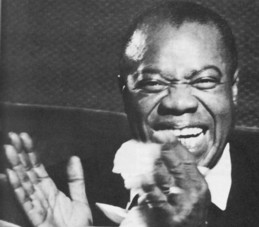
It's probably better known nowadays since Louis Armstrong's recording from the 50s was used on the soundtrack of Sleepless In Seattle (1993) . That leisurely baritone, just rough enough around the edges, plays against the sweet melody in a wistful kind of way, and of course there's a trumpet solo that bursts onto the scene as a bonus at about 1 min. 30 secs. All in all, it's a satisfying result.
(It reminds me of the way John Lennon's delivery adds some edge to that sad, sweet love song Baby It's You, when compared with the original version by The Shirelles.)
I'd always assumed A Kiss To Build A Dream On was from the 30s (it sounds as if it's from the 30s), so I was surprised to find that its first appearance seemed to be in a 1951 film, The Strip, sung by Louis Armstrong. It does have a copyright date of 1935, but I could find no earlier versions.
But, as is often the case, Joop Jansen had an answer when I asked at The Originals forum.
It turns out that A Kiss To Build A Dream On was originally a song called Moonlight On The Meadow. It was written by Kalmar and Ruby for the Marx Brothers film A Night At The Opera (1935), but it was never used. Oscar Hammerstein took the song and wrote new lyrics for The Strip (1951), and that's when it became A Kiss To Build A Dream On.