Showing posts with label SONGWRITERS. Show all posts

30 July 2026

Bigger in Oz (25): Oliver Cool - Oliver Cool (1960)

Bigger in Oz: tracks that were more popular in Australia than in their countries of origin.

See also: Only in Melbourne.

Oliver Cool - Oliver Cool (Paul Vance - Lee Pockriss)

Roulette single (USA) #R-4292 September 1960
London single (Australia) #R-4292 November 1960 

US charts: did not chart
Australian charts: #15 Sydney #24 Melbourne #24 Brisbane #16 Perth | #17 Australia

Co-charting Australian cover version:
Rock Martin - Oliver Cool
Rex single (Australia) RS-042 November 1960
Australian charts: #16 Perth


We are deep into novelty record territory here. 

Who's the most swingingest boy in school?
You are!
And what's my name?
Oliver Cool!
That's right!

To me and my circle as 10-year-olds this was hilarious. 

Australians had a soft spot for jokey, gimmicky records, and Lee Pockriss often appeared in the writer credits.  He and Bob Hilliard wrote Jo Ann Campbell's A Kookie Little Paradise (1960), with its Tarzan calls and ice cream loaded with bananas in the jungle. Another well-known Pockriss-Hilliard composition is Paul Evans's whimsical (Seven Little Girls) Sitting In The Back Seat (1959). 

Pockriss and his Oliver Cool co-writer Paul Vance wrote Bryan Hyland's Itsy Bitsy Teenie Weenie Yellow Polkadot Bikini. (The 16-syllable title is the gimmick - pretty much the main event - just as it would be three years later in the 14 syllables of Little Pattie's He’s My Blonde-Headed Stompie-Wompie Real Gone Surfer Boy which I suspect it inspired.)

Unsurprisingly, Oliver Cool is a name adopted for the performance. You can find strong views online about whether this was dancer-choreographor-actor-director Tony Mordente (1935-2024) or singer and skater Lawrence Sarapochiello (1933-2024). It appears that each used the pseudonym Larry Ellis at some stage in their career, which could explain why there is confusion, but I don't feel confident in calling it either way.

I was surprised to discover an Australian cover version of Oliver Cool that co-charted in Perth with the original. Not only that, but there is no doubt that the artist, Rock Martin, was the famous West Australian-born stage hypnotist Martin St James (1924-2015) who had an early career as a cowboy singer in a circus. 

Chart positions for this post:
Australian capital cities: Gavin Ryan's chart books. 
Australia: Grant Dawe's Top 100 Singles site.


Oliver Cool - Oliver Cool (1960)


Rock Martin - Oliver Cool (1960)

26 July 2026

Karl Hammel Jr (1961): Summer Souvenirs and Bounty Hunter

 This follows on from my previous post Bigger in Oz (24): Paul Evans - Show Folk (1960)


 Karl Hammel Jr - Summer Souvenirs (Paul Evans - Jimmy Krondes) 1961, #68 Bb, #60 CB, USA,

 Karl was previously heard on:
 The Nomads - Bounty Hunter (Jimmy Krondes) 1961 B-side, #116 [Billboard Bubbling Under]

Bounty Hunter was covered by:
 Al Caiola - Bounty Hunter   (Jimmy Krondes) 1961 (B-side of Bonaza #19 USA),

It is strongly reminiscent of:
 Duane Eddy - Rebel-'Rouser (Duane Eddy - Lee Hazlewood) 1958 #6 USA. 


aka as ... Cash Box, 8 Jul 61 
I never forgot Karl Hammel Jr's Summer Souvenirs from hearing it on the radio as an 11-year-old, but it wasn't a hit in Australia and it seemed to disappear without trace. 

In the 70s and 80s I bought old or reissued 45s by mail order, catching up with tracks I had missed out on buying as a youngster. Summer Souvenirs was near the top of my wants list, and I scored it at a reasonable price through a mail-in record auction. 

The Paul Evans in the writer credits was already known to me from his records (Seven Little Girls) Sitting In The Back Seat and Show Folk, but I still knew nothing about Karl Hammel Jr (See my post, Bigger in Oz: Paul Evans - Show Folk).

Along came the Internet, and people from the music industry started to launch their own websites, often with contact details. So it was that I could email Paul Evans to express my regard for Summer Souvenirs and to find out anything at all about Karl Hammel Jr. I had a prompt and friendly reply: Paul said he remembered Karl   - nice guy - but they had lost touch and he couldn't give me much background..

I now find (via Discogs.com) that Paul Evans's co-writer on Summer Souvenirs, Jimmy Krondes, was the manager of a New Rochelle NY band called The Nomads, and Karl Hammel Jr was a member.  

The Nomads released one single, with both sides written by Jimmy Krondes 

The B-side, Bounty Hunter (February 1961), was released as an A-side in Australia in June 1961. This is a guitar instrumental that prominently features Karl Hammel Jr. At the start of the track he whistles the main theme or melody once before he is joined by the guitar which then takes over the main theme, with Karl whistling in counterpoint. A cover version was released on a B-side by guitarist Al Caiola (March 1961) but without any whistling. 

Whenever I came across Bounty Hunter over the years I absently thought, "Oh yeah, that's the one that sounds a lot like Duane Eddy." 

In fact (I later realised) Bounty Hunter and Dwayne Eddy's 1958 hit Rebel-'Rouser are almost identical in their main melodies or themes. Rebel-'Rouser repeats the theme several times, without a bridge or chorus, but Bounty Hunter adds one after two runs of the main theme, and repeats it later. Both versions have varied instrumentation throughout.

Clips: main themes only

Duane Eddy - Rebel-'Rouser (1958)  

The Nomads - Bounty Hunter (1961)  

Al Caiola - Bounty Hunter (1961)  


Karl Hammel Jr - Summer Souvenirs (1960)


The Nomads - Bounty Hunter (1993)


Duane Eddy - Rebel-'Rouser (1958)

____________________ 

Bonus track


Al Caiola - Bounty Hunter (covering The Nomads, 1961)

Bigger in Oz* (24): Paul Evans - Show Folk (1960)

Bigger in Oz: tracks that were more popular in Australia than in their countries of origin.

See also: Only in Melbourne.

22. Paul Evans - Show Folk (Bob Hilliard - Robert Allen)

Carlton B-side (USA) #539 December 1960
London single (Australia) #HL-1777 March 1961

London single (NZ) #NZL-L 649 August 1961

US charts: Cash Box #98, Billboard did not chart
Australian charts: #23 Perth | #67 Australia
NZ charts: #17
*Another case of Bigger in Oz and NZ. 
 
 
New York singer and guitarist Paul Evans (b, 1938) has put in many decades as a prolific and versatile composer and performer. 
 
He is probably most recalled for his first and biggest US hit (Seven Little Girls) Sitting In The Back Seat, from 1959. The rest of his chart history is respectable, if unspectacular, but it is just part of a large and varied catalogue of songs that includes co-compositions recorded by other artists, as well as TV or film music and advertising jingles. Roses Are Red (My Love), a #1 US hit for Bobby Vinton, is often cited as an example of his successful co-compositions.
 
Show Folk is typical of Evans's light-hearted touch. Australians were fond of records with a spot of comedy or novelty. Two other droll American records of the era come to mind: Oliver Cool by Oliver Cool (1959) charted #17 Australia, but did not chart in the US (a clear case of Bigger in Oz), and Ambrose by Linda Laurie (1959) charted #52 USA, #33 Australia. 
____________________

The writers of Show Folk are Bob Hilliard and Robert Allen.
• Lyricist Hilliard (1918-1971) co-wrote Seven Little Girls, one of numerous credits over many years that include Bing Crosby's late 1940s hit Dear Hearts and Gentle People, Frank Sinatra's In the Wee Small Hours of the Morning on his 1955 album In The Wee Small Hours, and Ruby & The Romantics #1 hit Our Day Will Come (1962). 
 
See also, at this blog, Jo Ann Campbell's A Kookie Little Paradise, written by Hilliard with Lee Pockriss, his co-writer on Seven Little Girls.
   
Robert Allen (1927-2000) was a composer, and an accompanist for Perry Como and others. His compositions include Johnny Mathis's hit Chances Are (1957, #1 USA) and Doris Day's Everybody Loves A Lover (1958, #5 USA).
____________________

It is easy to find out about Paul Evans. His website includes well curated discographies, something not always found at artists' websites. More than that, he is accessible. When I emailed him, he replied promptly and cordially, and he has been available for online interviews, for example at ClassicBands.com and SongFacts
 
So, follow the links to explore Paul Evans's career, and here are some of the highlights in digestible form.  
 
____________________

Some notable singles by Paul Evans
• (Seven Little Girls) Sitting In The Back Seat (Bob Hilliard - Lee Pockniss) 1959 #9 USA) as Paul Evans & The Curls
Midnite Special  (Traditional, attributed here to Milton Schnapf) 1959, #16 USA)
Happy-Go-Lucky-Me (Paul Evans - Al Byron) 1960#10 USA, #9 Australia, #6 NZ
The Brigade Of Broken Hearts (Clint Ballard - Fred Tobias) 1960, #81 USA
Show Folk (Bob Hilliard - Robert Allen) 1960#98 USA [CB], #67 Australia, #17 NZ 
Hello, This Is Joannie (The Telephone Answering Machine Song) (Paul Evans - Fred Tobias) 1978, #6 UK, #22 Australia, #21 NZ
 
• See also the Paul Evans discography at paulevans.com.
____________________
 
Hits by others, co-written by Paul Evans 
The Kalin Twins - When (Paul Evans - Jack Reardon) 1958, #5 USA, #1 UK, #1 Australia) 
Elvis Presley - I Gotta Know (Paul Evans - Matt Williams) 1960, #20 USA, #1 Australia) 
Bobby Vinton - Roses Are Red (My Love) (Paul Evans - Al Byron) 1962, #1 USA, #15 UK, #1 Australia #1 NZ) 
Pat Boone - Johnny Will  (Paul Evans - Fred Tobias) 1961, #35 USA, #4 UK, #20 Australia, #5 NZ
 
In the collaborations, Evans's main role seems to have been as composer. For example, he tells Gary James at ClassicBands.com that he wrote the music for Roses Are Red in a couple of minutes during a recording session: Al Byron ... said, "Paul, I got this lyric." I made a joke. I said to the musicians "Take five. I'm gonna write a hit song now." And I took his lyric, which by the way was complete, the way you hear it on the Vinton record, I wrote the entire melody in one pass... I tried for a couple of weeks to top the melody, but I couldn't do it.... So, I can tell you my biggest hit song was written in 2 minutes. 
 
• See also Paul Evans' songs recorded by other artists, at paulevans.com.  
____________________
 
George Formby's last hit!
Paul Evans - Happy-Go-Lucky-Me (Paul Evans - Al Byron) 1960#10 USA, #9 Australia, #6 NZ)
• George Formby - Happy Go Lucky Me (1960, #40 UK)
 
Comic ukulele-playing singer Formby (1906-1961) was a huge star in British films and on records in the 1930s-40s. It is remarkable not only that he covered this track by Paul Evans, but also that he had some chart success with it, however modest. I'm sure that many British listeners, accustomed to Formby's original recordings, would have been unaware of the song's origin.
____________________

Happiness is ... a Kent cigarette? 
Ray Conniff And The Singers - Happiness Is (Paul Evans - Paul Parnes) 1965
Joe Sherman And The Arena Brass  - Happiness Is 1966 Billboard Breakout (local hit), Milwaukee 
 
The composition was used in ads for Kent cigarettes and thus became maddeningly familiar.

____________________

TV theme
CBS This Morning News (Paul Evans) 
 
Used from 1987 to 1990.
Audio and commentary at Network News Music 
____________________
 
Willie Nelson re-releases a Paul Evans song about Willie Nelson not singing with Paul Evans
Paul EvansWillie's Sung With Everyone (But Me) (Paul Evans) 1993
 
Evans explains that this is a song about the 84 artists that Willie Nelson had recorded with and the one artist he hadn't (and still hasn't) sung with - me.
It later appeared as a bonus Track 23 on Willie Nelson's 22 Legendary Duets (1996), not a duet but Paul Evans's unaltered solo. If that makes sense. 
____________________
 
A fondly remembered obscurity 
Karl Hammel Jr - Summer Souvenirs (Paul Evans - Jimmy Krondes) 1961, #68 Bb, #60 CB USA
 
This did not chart in Australia, but it was a favourite of mine as an 11-year-old after I heard it on the radio in Victoria.
 
Karl was in a New Rochelle NY band called The Nomads. They were managed by Paul Evans's co-writer on Summer Souvenirs, Jimmy Krondes, who also wrote both sides of their only single.

The Nomads' B-side, Bounty Hunter (February 1961), was released as an A-side in Australia in June 1961. This is a guitar instrumental that features the whistling of Karl Hammel Jr. A cover version on a B-side by Al Caiola (March 1961) dispenses with the whistling. 

See my separate post on Karl Hammel Jr's Summer Souvenirs and The Nomads' Bounty Hunter 

____________________
 

Selected sources, further reading: 1. Paul Evans's website includes a discography of releases under his own name. A discography of compositions recorded by others is archived here. 2. Paul Evans interviews by Gary James at ClassicBands.com and by Carl Wiser at SongFacts.com. 3. Paul Evans biography by Eugene Chadbourne at All Music.

Chart sources for this post:
Australian capital cities: Gavin Ryan's chart books. 
Australia: Grant Dawe's Top 100 Singles site.
New Zealand: Warwick Freeman's New Zealand Top 20 Singles of the Sixties
USABillboard Hot 100 (Joel Whitburn) by default; Cash Box: Frank W. Hoffmann's chart book.
UK: The Guinness book of British hit singles [archived here]


Paul Evans - Show Folk (1960)


Paul Evans - Happy-Go-Lucky-Me (1960)

 
George Formby - Happy Go Lucky Me (1960)


Karl Hammel Jr - Summer Souvenirs (1960)


Ray Conniff And Singers - Happiness Is (1965)


Paul Evans - Hello, This Is Joannie (The Telephone Answering Machine Song) (1978)


Paul Evans - Willie's Sung with Everyone (But Me) (1993)

03 October 2025

▶︎ Obscure Originators (35) Johnny Yukon

From my website's front page series about lesser known artists who performed the original versions of Australian or NZ records.

See also: the full collection of 
over 40 Obscure Originators features. 

____________________

Johnny Yukon's real name was Ben Gabus. He was from Texas, born in Galveston in 1931, but later lived in Lafayette, Louisiana where he could be heard regularly at the Jury Room Lounge. His composition Ride Away (With A Song In Your Heart) was released by Slim Whitman in 1954.

As Johnny Yukon, Ben recorded his own composition Made To Be Loved (1959). It didn't make him famous, but it charted #25 in Italy, and it had a good run Down Under through local cover versions.

In 1960 it was recorded twice in Australia: by top Sydney deejay John Laws, and by a new young talent called Adam, an alias of Ian B. McLeod, the enduring country music artist, producer and record label owner from Warragamba NSW.

Neither of those records was a commercial success in Australia, but in New Zealand it was recorded by The Keil Isles, also in 1960. They were a popular Auckland rock'n'roll band formed by Samoan-born Olaf Keil and his cousin Freddie Keil with a line-up that included other members of the Keil family.

Chart placings are hard to pin down for New Zealand in the 1960s, but Warwick Freeman's retrospective chart places The Keil Isles' version of Made To Be Loved at #2 New Zealand.

Ben Gabus released Made To Be Loved again in 1964, this time as Ben Gabus. This is sometimes mistaken for the original version, partly because of confusion between two record labels with the same name and catalogue numbers.

In his later years Ben lived in Lexington, South Carolina and ran the Ben Gabus Tree Service. 

____________________

For more about the song and Johnny Yukon, see The Keil Isles - Made To Be Loved

28 September 2025

▶︎ Bigger in Oz (21): Sounds Incorporated - The Spartans (1964) and 7 others

Bigger in Oz: tracks that were more popular in Australia than in their countries of origin.

See also: Only in Melbourne.

21. Sounds Incorporated - The Spartans (Trevor Stanford [known as Russ Conway])

Composition also known as Spartacus or Spartacus (The Spartans) 

Columbia single (UK) #DB7239 April 1964
Columbia single (Australia) #DO4447 June 1964

British charts: #30
Australian charts: #3 Melbourne, #10 Brisbane | #5 Australia
 
Also released in USA and Canada

Footage of Sounds Incorporated opening for The Beatles in Australia on their 1964 world tour makes it clear why they got the gig. This rocking, mainly instrumental, six-piece band from Kent are still a joy to watch, even if the video quality isn't terrific.
 
They expertly played saxophones, flutes, guitars, keyboards and drums, with an act full of energetic, often comical, physical moves. They knew how to put on a show, and their stage experience came from backing pre-Merseybeat American stars touring Britain, including Eddy Cochran with whom they also recorded.
 
Apart from the quality of their work, Sounds Incorporated were the ideal band to open specifically for The Beatles. Audiences of Beatlemaniacs might have fidgeted through a lesser vocal-and-guitar group, while they waited impatiently for the biggest vocal-and-guitar group ever. Sounds Incorporated were something altogether different, and so entertaining that I'm guessing nobody even thought of yelling out, "We want the Beatles!"
 
Both bands were managed by Brian Epstein. Sounds Incorporated supported The Beatles again in 1965 in the US and Canadaand members of Sounds Incorporated formed the brass section on the Beatles track Good Morning, Good Morning on Sgt. Pepper's Lonely Hearts Club Band (1967).  
 
The Spartans was the first Sounds Incorporated record to chart, in Britain and in Australia. In Britain it was followed by one other, but in Australia it set off a series of charting singles that lasted into 1965. 
 
Here are all the charting singles (Top 75) by Sounds Incorporated in Britain and Australia. 

Britain
April 1964 The Spartans #30
July 1964 Spanish Harlem #35

Australia
July 1964 The Spartans #5
Aug 1964 Spanish Harlem #22
Aug 1964 Rinky Dink #22
Sept 1964 William Tell Overture #2
Sept 1964 Maria #2
Jan 1965 Light Cavalry #71
March 1965 Cast Your Fate To The Wind #20
March 1965 Hall Of The Mountain King #58 
 

I have written before about Australians' fondness for an instrumental track. It helps to explain why Sounds Incorporated records did so well in Australia. It is also fair to assume that the impression they made on the trendsetters at the Australian Beatles shows would have played a role.

The Spartans was written by Russ Conway (b. Trevor Stanford 1925-2000), a star British pianist and composer who had nineteen Top 40 hits 1957-1963 including Side Saddle (1957 #1 UK) and Roulette (1959 #1).

Sounds Incorporated rearranged The Spartans to feature the alto flute as lead instrument after listening to a demo recording. Saxophonist-keyboardist Barrie Cameron told Disc magazine in 1964 that they were emulating a sound developed on stage while backing Brenda Lee on tour in the UK.

Composer Russ Conway performed The Spartans himself on stage in April 1964 in a benefit concert for the son of recently deceased singing star Michael Holliday, a longtime friend since their days together in the Navy. It was released in July 1964 on an album, Tribute To Michael Holliday. The YouTube post of the track includes the full liner notes.

Conway's performance offers a contrast to the Sounds Incorporated version. It has a majestic feel, not unlike a theme for an epic historical film (it reminds me a little of piano duo Ferrante & Teicher). It is still stirring, but in a different way.

NME 27 March 1964

The composition's US copyright registration adds an alternative title, Spartacus. The title Spartacus (The Spartans) is seen on a more guitar-based German single by Liverpool band Ian & The Zodiacs (1965) and on German issues of their album Star-Club Show 7 (1965). A re-orchestrated track by Les Reed And His Orchestra on their album Love Is All (1969) is also Spartacus (The Spartans).

 ____________________  

An Australian footnote: Essex-born Trevor White was a member of Sounds Incorporated when the band broke up in Australia in 1971. He stayed on to become a permanent Australian resident, first becoming known here for his starring role in the original Australian production of Jesus Christ Superstar (1972) 

White was not in Sounds Incorporated for their Beatles tours, or for their charting singles 1964-65, as he did not join the band until 1968 upon Barrie Cameron's departure.

 ____________________  

Chart positions
• Britain: from The Guinness book of British hit singles (1983)
• Melbourne and Brisbane: as calculated retrospectively by Gavin Ryan
• Australia: from Grant Dawe's Top 100 Singles site. 
 

Selected sources:
• "No vocals for us, say Sounds Inc.", Disc, 9 May 1964 (Barrie Cameron on recording The Spartans)
• "Sounds Incorporated", Record Mirror, 9 March 1968 (Sounds Incorporated's new organist Trevor White will be joining the group when Barry Cameron leaves in mid-March ...)
(Links are to digitised copies at WorldRadioHistory.com) 


Sounds Incorporated - The Spartans (released April 1964, recorded in January) 

 Sounds Incorporated - The Spartans live on Beatles tour, Australia (July 1964)


Russ Conway - The Spartans, live in concert (June 1964)


Ian & The Zodiacs - Spartacus (The Spartans) (1965)


Les Reed And His Orchestra With The Eddie Lester Singers - Spartacus (The Spartans) (1969)

13 June 2025

▶︎ Obscure Originators (33) Bobbie & Dude

From my website's front page series about lesser known artists who performed the original versions of Australian or NZ records.

See also: the full collection of 
over 40 Obscure Originators features. 

____________________

Country and pop singer Maria Dallas was a star in New Zealand. Her first single Tumblin' Down (1966, #11 NZ) won the prestigious Loxene Golden Disc Award, but her most successful single in NZ was Pinocchio (1970, #1), her fifth to chart Top 30 there.

In Australia, though, Maria's biggest hit was with Ambush (1967, #16), recorded in Nashville where she went after working in Australia for a while. The song stood out for its unforgettable rhythmic line at the end of verse and chorus: Your kissin’ leavin’ good-time days are dead. It was later recorded by Teresa Brewer (1975) and by Australian country artist Craig Giles (1993), but Maria's was the original release.

Ambush had been copyrighted a few months earlier by its composers, two sisters from the small Texas town of Moody, near Waco. As it happens, Maria Dallas was also from a small town, Morrinsville in New Zealand.

Bobbie Jo and Elizabeth Ann Brown had been singing from an early age in The Brown Sisters, a solidly booked country-gospel trio with another sister, Bettie.

Montreal, 1967
By the time of Ambush they were a duo called Bobbie & Dude. The stage name Dude was adopted by Elizabeth because it seemed to go better with Bobbie. They toured widely, and performed during Expo ’67 in Montreal where their only single had some radio airplay. As far as I can see they did not record Ambush themselves.

For a long time I knew almost nothing about Bobbie & Dude apart from their writing credits for Ambush and a few other songs. I was puzzled by the addition of Elizabeth Ann Brown to co-writer Dude Brown's name in Ambush's copyright registration, but I had never thought of searching for "bobbie and dude" in quotes.

As I have often typed here, Eventually, someone emails. This time it was someone who knew Elizabeth Ann well, and their tantalisingly brief words gave me the clues I needed.

____________________

For more about the song and Bobbie & Dude see Maria Dallas - Ambush

22 May 2025

▶︎ Hal Saunders: songwriter, playwright, printmaker and more

Hal Saunders (1904-1991) was born James Hallett Saunders in Armidale NSW. He was a prolific songwriter who made a name for himself writing radio serials from the mid-1930s before going into the music business in the 50s and 60s. He was also a visual artist specialising in etching and printmaking. 

On his retirement from Festival Records in 1965 (noted in Billboard and Cash Box)Saunders was referred to as a producer, composer, arranger and musical director. That is a good start, but it leaves out lyricist, adapter, jingle-writer, scriptwriter, A&R man, pianist and bandleader

Michael Looper has tracked Saunders' job titles at Festival from 1954 to 1960: musical director, musical consultant in charge of local recording activities, recording supervisor and assistant A&R manager. He was a prominent office-holder and advocate in songwriters' associations including APRA in the late 40s-early 50s. 

Women's Weekly 6 June 62 [source]
Anyone who digs into the history of Australian popular music will come across Saunders' name in songwriting credits. In 1949, when he was President of The Australian Composers and Songwriters' Association, the Sydney Morning Herald called him Australia's most prolific songwriter who had copyrighted about 1,000 songs from the previous 15 years.1 He often worked behind the scenes, for example when he produced Lucky Starr's hit I've Been Everywhere (1962) without any credit on the label. 

In the first half of the 1960s he wrote and (mainly) co-wrote for the latest crop of young pop stars at Festival. Frequent among his collaborators were influential Festival A&R man Ken Taylor and the multi-talented Franz Conde, at this time time a musical director at Festival. 

With Taylor, Saunders wrote or arranged for Vic Sabrino, Johnny Devlin and Ray Melton. With Conde, there were a lot of adaptations: traditional children's songs, a Christmas EP for Noeleen Batley, and an EP of traditional celebration songs for Col Joye

As an adapter, Saunders also contributed to Jimmy Little's hit version of the old gospel song Royal Telephone (1963), and he wrote the English lyrics for Noeleen Batley's Little Treasure From Japan (1964) from the Japanese song Konnichiwa Akachan. April Byron, Judy Stone, Patty Markham, Noeleen Batley, and Lana Cantrell all recorded tracks with credits to Hal Saunders as writer, co-writer or adapter. 

_____________________________

It is hard to say where Saunders contributed as composer or lyricist in his collaborations, but he was capable of either. 

As a pianist in the 1930s he had led a swing quartet, Hal's Vagabonds, for at least one gig in Northern NSW, and his job descriptions at Festival included arranging and musical direction. Besides, his solo compositions confirm that he write both lyrics and music. 

As for lyrics, when Peter Scriven produced Tintookies (1956), his well-known marionette musical for children, Saunders wrote the book and the lyrics

For Nex'Town (1957), a musical devised and produced by Scriven, Saunders co-wrote the music and lyrics. His collaborator on Nex'Town, Iris Mason, later co-wrote the music for Saunders' own work for marionettes, Tales From Noonameena: an Operetta for Children (1973), staged at the opening of the Sydney Opera House.

 _____________________________ 

Saunders' ability as a lyricist is unsurprising. He had started earning a living as a writer for Sydney radio during the 1930s when he wrote advertising copy and lyrics for jingles, but he went on to become one of the top radio playwrights in the country. 

Nov 1935 [full story]

He is often identified with his popular serial The Black Spider (1935), a mystery set in Sydney that was first aired on 2KY, later on 3XY and other stations. A novelisation was published by Magpie Books in 1945.

A Sydney newspaper story in November 1935 announces the final episode of The Black Spider, but plugs a forthcoming comedy by Saunders, Gambler's Luck, as well as his Sunday morning adventure serial Jack Strong's Gold Reef. A few weeks later 2KY was airing Saunders' true-crime-based serial Sydney's Crime Sheet (early 1936), apparently commissioned in response to a similar show on another station.

This activity signalled a boom time for Australian radio that would last into the 1950s, an era when Australian variety and drama dominated programming. As Will Newton puts it in an overview of the period, I have always thought that Australian radio drama came into its own thanks, largely, to Hal Saunders. 

_____________________________

Away from the performing arts, the Australian Prints + Printmaking website has information about Hal Saunders, a print-seller, printer, printmaker, publisher, and writer, noted for his etchings. 

A reader might not guess that this is Hal Saunders the A&R man or the writer of The Black Spider, but the connection is made clear in a February 1937 Wireless Weekly article. Saunders talks about a medical crisis that forced him to abandon an earlier career in the legal profession. After recovering, he studied Art, and in 1928 he "toured New Zealand on behalf of the Commonwealth Government with paintings and etchings by Australian artists".

At the time of the Wireless Weekly article, Saunders had just written Hotel Revue, a musical comedy for radio with music by pianist Cliff Arnold

Saunders says he "brought along half a dozen melodies" to the first meeting with Arnold but confessed his "knowledge of music was non est". Perhaps this meant that he lacked knowledge of musical technicalities, or perhaps he was being modest, or just building a narrative. Whatever the explanation, by December of 1937 he knew enough to handle the piano in Hal's Vagabonds, and by 1954 he was a musical director at Festival Records. 

_____________________________

1. It is hard to verify the 1949 reporter's figure of about 1,000 songs in 15 years, but a song every 5½ days or so seems doable. Besides, Saunders' voluminous output as a radio playwright shows that he had the drive and ability to work quickly and prolifically.

Sources
• Many newspaper and magazine articles at Trove.com.au, Newspapers.com and NewspaperArchives.com, so allow for reporters' errors and recycling of promotional material. See links in the text and email me for more.
• Discographic data at 45cat.com, 45worlds.com and Discogs.com.
• Nancy Bridges, Wonderful Wireless (1983) pp 48-50
• Will Newton. "Wonderful World of Wireless: Golden Years of Radio", Sutherland Shire Historical Society Inc Quarterly Bulletin, February 1993

_____________________________

The Black Spider premières, October 1935 [source]

   To-night at 6.45. the first episode in “The Black Spider,” a 2KY mystery thriller, will be presented. Written by Hal Saunders, 2KY Playwright, “The Black Spider,” is a gripping story of crime and murder set in and around Sydney. The ingenuity of "The Black Spider" and his gang tests to the utmost the skill of Inspector McMillan and his colleague. Martin Purlow, the famous detective.  Besides the intense and exciting action which permeates the whole of this story, the author has introduced a generous splash of mystery, which makes it safe to assume that right until the final episode the true identity of "The Black Spider" cannot even be suspected.  In the presentation of this original all-Australian serial. 2KY is definitely making radio history, for this is the first occasion on which a serial of this type has been featured by any Australian broadcasting station. Included in the cast are: Dan Weldon, George Jennings, Harry McDonald, and Sylvia Post Mason.


February 1936: Sydney's Crime Sheet [source]

September 1940: The Secret of Smokyville [source]

23 April 2025

▶︎ Obscure Originators (32) The Meantime

From my website's front page series about lesser known artists who performed the original versions of Australian or NZ records.

See also: the full collection of 
over 40 Obscure Originators features.

____________________

Johnny Farnham's cover version of Friday Kind Of Monday (1968) was a hit in Australia (#6) and New Zealand (#11).

The original version from 1967 was by The Meantime, a group that came out of nowhere, released this one single that failed to chart Top 100, and that was it.

This looks like a clear case of obscurity until you follow the lead in the writer credits. Friday Kind Of Monday was written by Jeff Barry and Ellie Greenwich, one of the most successful songwriting teams of the 1960s, and a married couple from 1962 to 1965. 

As Billboard announced (above), the lead singer on the Meantime single is Ellie Greenwich but, more than that, the whole recording is a studio project by Greenwich and Barry.

They had previously written and recorded as The Raindrops whose seven singles 1963-65 included He's The Kind Of Boy You Can't Forget (1963 #17 Bb, #15 CB) and What A Guy (1963 #34 CB). They charted moderately in most Australian cities, but in Adelaide they had hits with Kind Of Boy (#4), and That Boy John (1963, #12).

When you listen to a Raindrops record, you are most likely hearing Greenwich's voice double-tracked, with Barry's bass vocals and prominent drumming. For live appearances and for photos of a trio, other personnel were recruited.

The Meantime was a similar project, a Raindrops for the late 60s, created in the studio by Barry and Greenwich. (There is a cryptic clue in the group's name: think Greenwich Mean Time.)

All of this reminds me of Leiber and Stoller's view that We don't write songs. We write records.

____________________

For more about the song and The Meantime see Johnny Farnham - Friday Kind Of Monday

14 March 2025

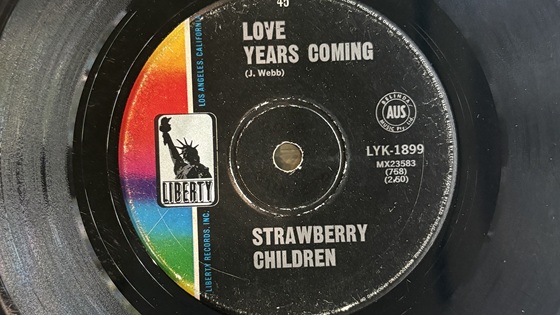
▶︎ Only in Melbourne: (5) Strawberry Children - Love Years Coming (1967)

Only in Melbourne: tracks that didn't chart Top 40 in their countries of origin but did better in the capital of my home state, Victoria. See also: Bigger in Oz.

(5) Strawberry Children - Love Years Coming
(Jimmy Webb)
USA 1967
Soul City single (USA) #758 / SCR 758
Liberty single (Australia) #LYK-1899
55597
Australian charts: #17 Melbourne (#50 Australia)
Released in Australia August 1967, charted September 1967.
US charts: Did not chart Top 100 Billboard or Cash Box.

Survivor of my teenage record collection pile

When I bought this single as a 17-year-old in 1967, the writer credit (J. Webb) meant nothing to me. 

A hit Jimmy Webb composition had already entered the charts here in July, The 5th Dimension's Up, Up And Away (#1 Australia, #7 USA). It carried the same clipped credit on the Australian label (J. Webb) but I didn't own that single and wouldn't have made the connection.

Songwriters can toil away for years creating famous songs for famous artists without ever becoming famous themselves. My feeling is that in September 1967, when Love Years Coming was charting in Melbourne, Jimmy Webb hadn't yet joined the group of exceptions, songwriters who become household names, but the process was well under way. 

After several months at Motown Records, he had been signed to the publishing company owned by Johnny Rivers, also owner of the Soul City label. During 1967 Jimmy Webb compositions dominated albums by The 5th Dimension (Up-Up And Away and The Magic Garden on Soul City), and by Johnny Rivers (Rewind on Imperial). In late 1966 Rivers' album Changes had included the original version of what would become a much-recorded Jimmy Webb classic, By The Time I Get To Phoenix.

In May 1968 came Richard Harris's MacArthur Park, a startling work that inevitably drew attention to its composer. It was followed by Glen Campbell's Wichita Lineman (#5 USA) in the same year then, early in 1969Brooklyn Bridge's Worst Thing That Could Happen (#3 USA) and Campbell's Galveston (#4 USA). There are many others, and to browse further I recommend the 4-page Jimmy Webb discography by Hiroto Yanagida.

Love Years Coming, which I loved, carries the era's familiar message of peace (the lion shall lie down beside the manchild) and I took Strawberry Children to be another one of those fine American bands that were emerging after the initial shock of the British Invasion, bands like The Association, The Box Tops, The Doors ... 

Years later I had read with pleasure that Jimmy Webb was Strawberry Children. More accurately, though, this is Jimmy Webb with a studio band assembled for the session, a practice that was more widespread than we realised at the time, and certainly not confined to the first recordings of The Monkees.

The team at the Jimmy Webb Facebook page confirms that he is on lead vocals, with Hal Blaine on drums and Larry Knechtel on guitar, both from the ubiquitous LA session team now known as The Wrecking Crew

Don't miss the comments and photos at the Facebook page highlighting other personnel on the record including singers Endore’e Lukem, and "J.W. school friends" Glen De Lange and Mike Reilly.

There were no further Strawberry Children releases, so their only other track was the B-side, One Stands Here (J. Webb), a nicely arranged instrumental that could hold its own on a TV or film soundtrack.

---

See also Al Wilson - Do What You Gotta Do, another Only in Melbourne song written by Jimmy Webb.


23 January 2025

▶︎ Obscure Originators (31) The Fun And Games

From my website's front page series about lesser known artists who performed the original versions of Australian or NZ records.

See also: the full collection of 
over 40 Obscure Originators features.


The Grooviest Girl In The World
was a #3 New Zealand hit in 1969 for Hutt Valley band The Simple Image.

The original version was released in the US in 1968 by The Fun And Games, a six-piece band from Texas with four members who had been band-mates since their high school years in Houston. They included the Romano brothers, Joe and Rock, who both went on to successful careers in various branches of the arts (there is a Wikipedia page about Rock).

The Fun And Games 1969 [link]
The Fun And Games version of The Grooviest Girl In The World was produced by one of its writers, Gary Zekley. He is partly known for singing, co-writing and producing on the single Yellow Balloon (1967 #25 USA) and the subsequent album by The Yellow Balloon. These later became artifacts of the retrospectively named genre of Sunshine Pop. 

The Simple Image were one of those fine New Zealand bands of the 60s-70s that topped the charts in New Zealand with records that were unfamiliar to most Australians. NZ artists such as The Simple Image, The Dedikation, The Avengers, and The Fourmyula had #1 or #2 NZ hits that never surfaced in Australia.

There's a twist to the story of The Grooviest Girl In The World that I discovered later. Although most Australians would not be able to hum the tune for you, a Boomer from South Australia might know it. The original version by The Fun And Games charted in Adelaide March-May 1969, peaking at #3. (That averages out to #72 Australia; in the US it reached #78 Billboard.) This is a surprising outlier which I suspect is down to radio airplay on Adelaide's 5AD. 

____________________

For more about the song and The Fun And Games see The Simple Image - The Grooviest Girl In The World