 You don't have to look far to find examples of boofhead in Australian English.
It's time for Bozo and Boofhead to go, says a Melbourne Age headline about obnoxious footballers; an ABC radio site had Boofhead of the week, an inept home handyman. It appears in plenty of blogs, which may give you a flavour of its usage, and Google Image results for boofhead are also instructive.
I guess a boofhead is what Mark Twain would've called a puddenhead, maybe with some sense of what the Brits call a likely lad. A boofhead is a bit slow, maybe clumsy and unthinking, a likeable clot. It can be a friendly term (the inept handyman), but a boofhead can also be uncouth and boorish (the obnoxious footballers). You could say the behaviour of yer soccer hooligans is a bit boofy.
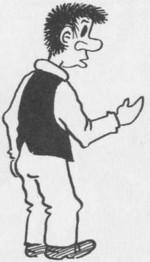
The image of Boofhead the character (above) is from R.B. Clark's daily comic strip. Boofhead ran in Sydney's Daily Mirror and in comic book reprints from 1941 until its creator's death in 1970.
It's one of those instantly recognisable Australian images, adopted by Mambo design and by the artist Martin Sharp for Regular Records. The Powerhouse Museum's website shows showed Boofhead on a 1966 Oz Magazine cover by Martin Sharp. There's even a statue of Boofhead in a park at Leura in the Blue Mountains.
You could say the strip itself has an endearing boofheadedness about it, with its daft situations and its two-dimensional artwork (as far as I know, Boofhead himself is always seen in profile, Egyptian-style).

John Ryan, the Australian comic strip historian, puts it this way:
Boofhead - drawn by Bob Clark and featuring a simplistically drawn, waistcoated young man with an elongated nose sheltered by a cantilever hairstyle - was amateurish and the humour mundane. It is difficult to fathom the reasons that this strip attracted readers but there can be no disputing its popularity. (In Panel by Panel: An illustrated history of Australian comics, 1979.)
An Australian National Dictionary updates page has citations for boofhead from 1941 and 1942, but doesn't mention the comic strip. I'm assuming the word predates the comic, and the comic helped popularise it, as John Ryan suggests: Boofhead brought back into common usage the term 'boofhead' in describing a simpleton or fool.

8 comments:
I can see why it was popular. I crack up just looking at Boofhead and his dopey, vacant face.
The front cover of the comic "The Dizzy Doings of Boofhead" No13 shows a 3/4 view of Boofhead's face.
I always loved Boofhead as a kid, 60 years ago.
Now in March 2011 we have a Councillor at Lithgow in trouble for using the word in a council meeting.
There is of course the usual conjecture as to who it was made to and this is costing ratepayers a lot of money, money that could be spent on a lot more worthy things.
While it is being said it is in the interest of "decorum" in the council meetings, there are plenty of people saying it is really another conflict between two people who dislike one another immensly.
Bill
It's good to hear that there is still a bit of the real Australia in Lithgow which was once a real battling Australian town with a great history. Don't let Political Correctness triumph!
I knew R.B. Clark's nephew (now deceased) in the 1960's. He was a very intelligent, though cynical, character with a biting wit. He told me over a beer in an inner city pub that his uncle reckoned that the wide appeal of the comic was with people frustrated in their lives who gained a buzz from laughing at Boofhead, one person who was clearly less able and successful than themselves. The comic was widely read in the late afternoon Sydney trains.
Thanks Jack, great comment. Just tidied up those missing links.
R.B. Clark was my grandmothers uncle, I have the complete works, some original drawings and a short story written about Boofhead. A very interesting read.
Very pleased you guys have this information. Years ago I searched the web for Boofhead and complained that I couldn't find a reference. I told my wife so she went out and bought me comic number 1 in mint condition. I'm happy that I still have it
Although it is eight years since your post, I would like to talk to you if at all possible. Rick Milne 0418 339 103
Post a Comment