10 March 2023

▶︎ When oldies stream the oldies


oldie [Macquarie Dictionary]
• someone regarded as old by the speaker...
• something old, especially a popular song 

1. Real music: are we there yet? 
You can listen to a lot of oldies at YouTube now, and they attract a lot of comments from oldies.

Some YouTube commenters of my generation can't celebrate the music of their youth without adding that, by contrast, artists these days can't sing, can't play, and don't know how to write songs. (Oh, and they are not as well groomed. Probably not a musical issue.) 

Of course it's not true: the sounds are different, but every generation has its geniuses and their mediocre imitators. It's doubtful whether the commenters have actually listened to much current music, which I admit is now dizzyingly fragmented and does take some effort to get a handle on. The days are long gone when "current music" pretty much meant the few songs that were being played on the radio this week.

In any case, it sounds too much like reactions from our parents' generation to rock'n'roll (to take one inter-generational scenario). 

Examples are easy to find. From 1964, a feature writer sums up the BeatlesThis badly-in-need-of-a-haircut group can't sing.....period [link; my hyphens]. And from 1965: a music publisher complains that  lyrics this day and age are appalling and are rendered by so called singers with so called voices.... [link], and a columnist hopes for a revival of big band music for those of us who still enjoy dancing to real music... [link].

At YouTube today you will see the phrase real music used to boost the music of the past. A comment addressed to youngsters advises them that a Billy Preston track from 1974 is real music.

Daily Telegraph (UK) 1904 [link]
This concept of real music goes back at least as far as 1910. A show is recommended by the Sioux City
Journal because it will feature not ragtime nor "popular" music but real music [link]. (My impression is that real music c.1910 could also mean live as opposed to recorded music, still relatively new-fangled but gaining popularity.)

---

2. When too much is barely enough.
You'll see comments under an old song at YouTube where the user "misses" the music of their youth. They pine for the 60s when the music was great. They want to go to back to the 70s just so they can hear all these great songs. 

It would be too clever of me to point out that they have just listened to one of those great songs, right there at YouTube. They can repeat the track or save it for later, or browse thousands of others. How could they be missing it? 

Through streaming services like Spotify and Apple Music, as well as YouTube, we can now access mountains of recorded music from any time in the history of the recording industry. Blimey, here's Billy Murray from 1911, off an Edison cylinder: Spotify

It's true that Spotify and Apple Music don't stream unreleased material or tracks that have never been reissued. 

Luckily though, YouTube has gone beyond its remit of being a video site to become a repository of music so vast that you seem to be able to find almost any track you can think of. 

This has happened partly because many serious record collectors have posted their collections to YouTube, often with just a still photo of the 45 on the video screen. 

If you want to avoid the ads, and the amateurish slideshows and animations that accompany many songs, you can upgrade and listen on the Spotify-styled YouTube Music app. 

British Invasion cloud at Every Noise
At streaming services like Spotify it's not all current pop hits and 1960s oldies. I've rarely been disappointed when I've searched for tracks from any decade in any genre: try jazz, classical, folk, bluegrass, swing, blues, or hillbilly. 

If you're short of genres, you could take a peek at the clouds of over 6,000 of them at Every Noise At Once, each with a link to a Spotify playlist. Japanese chill rap? No problem, and here's the playlist, with links to 15 related playlists including Guatemalan pop and Malaysian Hip Hop.

At this point, I'm starting to sympathise with the YouTube commenters. Part of me does miss switching on a Top 40 radio station deep in the 60s and listening to whatever they played, song after song, without any choices apart from twiddling the dial across to a rival station.

---

3. You mean there never was a golden era?
Years ago I wrote to Graham Evans at the ABC's Saturday night radio show Sentimental Journey. I posted a letter, in an envelope with a stamp: it was 1983. I was looking for the name of a 1930s song I'd heard. (It was Bunny Berigan - I Can't Get Started, which shows how little I knew at that stage.)

I also commented on the surprisingly high quality of music that he was playing from the 30s. When Evans wrote back with the name of the song, he surprised me by adding that there was plenty of bad music in the pre-WW2 era, and he was selecting the cream of it for his program. So my impression of a golden age was flawed, and I admired his candour.

When it comes to the music of our youth, we curate our listening so that we select our idea of the best of the era. We forget the sentimental balladry and corny novelties that sat side-by-side with the some of the grooviest songs in history.

There were second rate and third rate artists in our youth just as there are now. Try listening to an album by some of our idols from the 60s that had one or two hits filled out with mediocre copycat compositions, or pedestrian covers of other people's hits.

I'm sure that in Bach's or Mozart's time there were hacks churning out paint-by-numbers compositions, but we tend to stick with Bach and Mozart and their gifted contemporaries. 

---

4. You had to be there.
I sympathise on one other point with my contemporaries who wish they could travel back in time, even though I go along with the killjoys who reply with lists of diseases and injustices you would endure if you did manage to slip back to 1965. 

Replaying the music of your youth lacks the experience of hearing the music unfold as it appeared, in the context of the times. 

The Beatles delivered surprise after surprise during my teenaged years, from the first trickle of singles on Australian radio in 1963, through a series of albums that (for me) culminated in the scintillating Abbey Road in 1969. 

The 3,000 mainly teenaged fans who swarmed Carnegie Hall in 1938 to hear
Benny Goodman's
orchestra were having that same experience, and although I have listened to a lot of Goodman's records from that time, I can never replicate the joy of being there, at that time, as the narrative unfolded.  


Link:
Every Noise At Once: over 6,000 musical genres mapped with playlists and artist clouds

Benny Goodman And His Orchestra (Gene Krupa, drums) - Sing, Sing, Sing (Carnegie Hall Concert, 1938)

26 February 2023

▶︎ Lost in the 30s

I was born into the target audience for rock 'n' roll: Bill Haley in Grade 1, Beatlemania as I turned thirteen, and soul, folk-rock and psychedelia by the end of high school.  

In my 30s, though, I went for months when I listened to almost nothing but the music of the 1930s, bookended by a little late 20s and early 40s. 

I was mainly drawn to the swinging big bands, the golden age songwriters, and the sweet British dancebands (sweet isn't my word: it names a genre). I knew when I'd wandered too far into maudlin 40s dancehall ballads or cheesy novelties from the 20s. 

My pathway was through the ABC's Saturday evening radio show Sentimental Journey. I used to hear some of it when I left the station on after the 7 o'clock News. I ended up staying for its full two hours every week. 

I could not miss one episode, and I recorded many of them on C90 cassette. One Saturday after the News, the ABC neglected to switch its regional network across to the city network that carried Sentimental Journey. I phoned the ABC in Brisbane and was put through to a sceptical technical chap who finally took a look and fixed it.

---

ABC Radio 1984 [link]
Sentimental Journey’s music was pre-rock 'n' roll but skewed to the wartime 40s and to its true heart, the 30s, with forays into the late 20s. 

The title Sentimental Journey was from the song of that name, first recorded by Doris Day with the orchestra of co-writer Les Brown in 1945. It suggests that the program was aimed at my parents' generation for whom returning to the music of the 30s and 40s might indeed have been a sentimental journey. 

But that was the only hint in that direction. As I recall, the word nostalgia or notions of reliving the good old days were rarely, if ever, mentioned (although nostalgia was in presenter John West's own vocabulary). There were no cliches like What you were doing when you first heard this? or Ah the days when you could get an ice cream cone for a halfpenny!  Certainly nothing like They don’t write songs like that any more.


In fact, this was its strength. There was this unspoken integrity about treating the music with respect, and allowing it to stand on its own merits, always. 

The enthusiasm was for the music and its creators, not for its association with anyone’s golden memories. That was left to the listener to fill in for themself. Or not, as in my case. 

 For a newcomer like me, this was perfect. Because there was no assumption that the listener was here to relive the past, I was able to experience the music directly, without feeling I was eavesdropping on the reminiscences of another generation.

If at first some of the arrangements and productions sounded old-fashioned, the more I immersed myself in the era the more it felt like familiar territory, free of any superficial cultural associations.

As a primary schoolteacher I used to run a lunchtime movie club where I played black and white silent-era comedies to 8- to 10-year-old film buffs. At the first session I told them these would be unlike other films they’d seen, and I had them mime putting on their "old-time movie glasses", like putting on sunglasses for the beach. 

At first it was like that with me and 1930s music. It wasn’t exactly the same as listening to any genre that was familiar to me: I was adjusting my ears by putting on an imaginary pair of custom-made 1930s headphones.  

---

John West 1989 [link]
The host of Sentimental Journey, John West (1924–2008), covered theatre for the ABC for many years through his program The Showman. He was urbane and briskly articulate - he never wasted a word - and he had a mischievous wit that he never overdid.

Also presenting segments were collectors or aficionados of old records, notably Graham Evans whom I remembered from Melbourne commercial station 3AW. Other features would appear, including a fine series of reminiscences by golden age songwriter Sammy Cahn. (His recurring phrase the phone rang inspired my website’s catchphrase eventually, someone emails.)

British danceband singer Al Bowlly (who was new to me) popped up regularly. This reminded me of the 1970s cartoon in Stereo Review showing a man listening to a radio. Played now by the orchestra of the Academy of St Martin in the Fields says the announcer, and the parrot answers back Neville Marriner conducting. If that same parrot had heard the words Al Bowlly on Sentimental Journey, it would have squawked out Ray Noble And His Orchestra

In the request segment at the top of the program, the most popular track was Cole Porter's Begin The Beguine as sung by Chick Henderson with Joe Loss And His Band (1939). I'm sure this became the definitive recording of the song for Sentimental Journey listeners like me.
It wasn't all British dancebands, though, and the playlists ranged widely. Among the highlights was discovering the likes of Annette Hanshaw and Ruth Etting, good-humoured pioneers of electric recording who were able to tone down their delivery to a more intimate, conversational level (Hanshaw would finish a song with a cheery "That's all!"). Bing Crosby's forthright, less mannered early recordings were a revelation, as I had known him only from later years when he had adopted the almost self-parodying persona of a senior crooner. I fell for Artie Shaw and Benny Goodman, and reflected on how exciting it would have been to be hearing their music when it was new, just as it was exciting for our generation to have heard Elvis Presley or The Beatles or Aretha Franklin for the first time. 
 
Sentimental Journey continued after John West’s retirement in 1989 but ended early in 1996 (to some crotchety reactions). It was eventually replaced by a flashback show that was all about remembering the good old days. Unlike Sentimental Journey, the word "nostalgia" was mentioned early, and I soon tuned out.

---

This affinity with old-time records didn’t come completely out of nowhere. I had been softened up by hearing  the Red Onion Jazz Band a few times at Melbourne University from 1969. They played good-humoured trad jazz at its joyous best. When I sought out a song they played, Diga Diga Doo, I found it on Flaming Youth, a renowned album of Duke Ellington tracks from the 1920s that I ended up playing as often as any other LP I owned.

My parents bought a lot of LP records in the 1950s, so they would have been able to hunt down reissues of music from their teens and twenties. But the only authentic pre-war music I ever heard in our house was on an LP released in the wake of the film The Glenn Miller Story (1954). Mum and Dad were early adopters of stereophonic sound, so when the old songs turned up they were often in orchestral versions that exploited stereo to full effect (Clebanoff, Mantovani), and sometimes by other recyclers of old tunes such as Ray Conniff And His Singers or Mitch Miller And The Gang. I'm guessing that for my parents a return to the authentic music of their teenage years - the years of Depression and the outbreak of war - did not offer a sentimental journey.

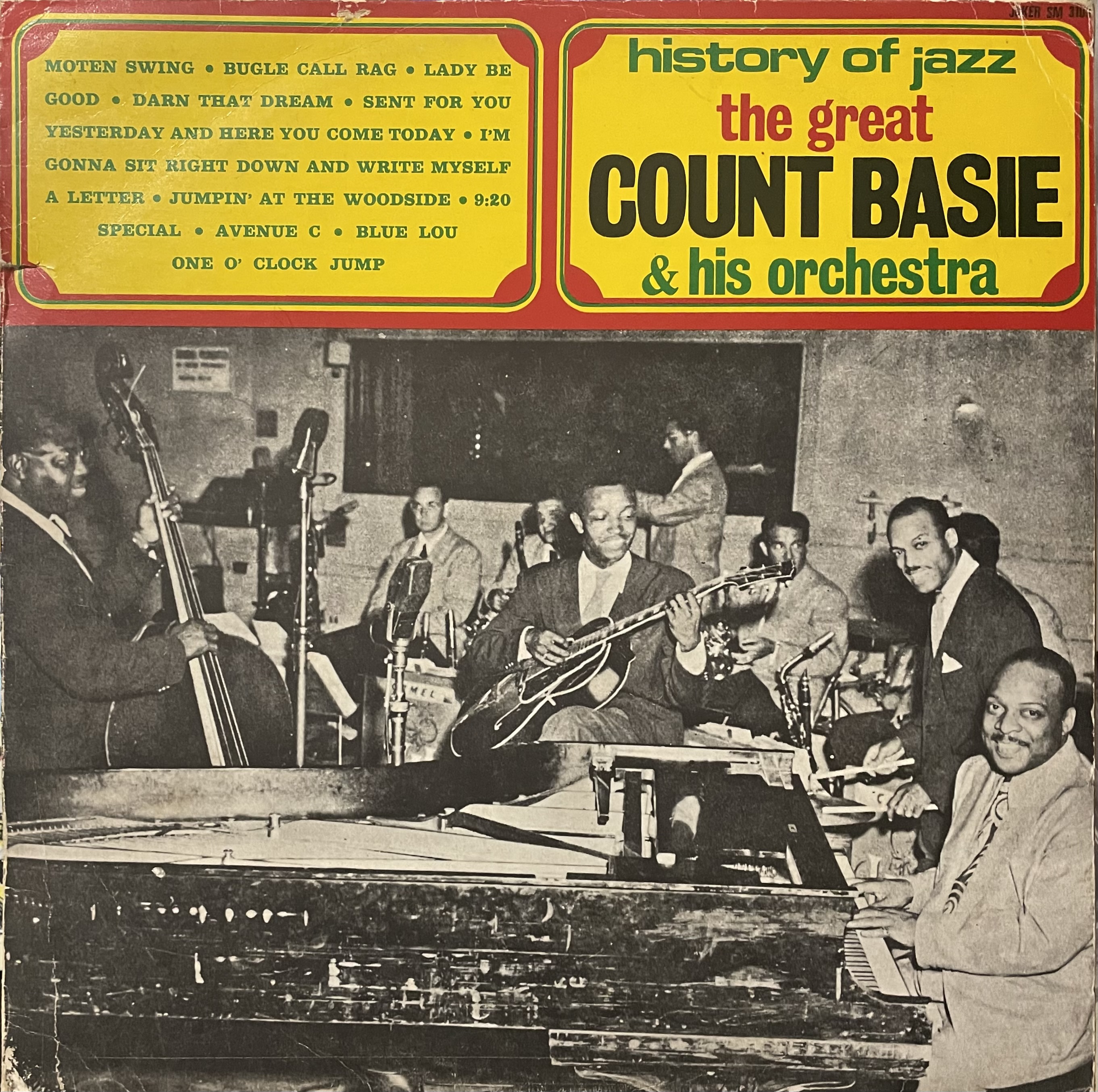
This meant that I heard a lot of music during my school years, but not much from the pre-war years. By the early 80s my whole collection of 20s-30s-40s music had been Ellington's Flaming Youth and one album each by Fats Waller, Django Reinhardt, and Count Basie. Oh, and one outlier by British comic actor and talented ukulele player George Formby, known to me from TV reruns of his old films from the 30s. (I recently rewatched his 1935 film No Limit to groans from the other half of the household.)

When I discovered Sentimental Journey in the 1980s it was a good time to be buying good quality reissues of records from the era of 78 rpm discs. 

I bought an audiocassette of The Songs & Stars Of The Thirties (1980) an anthology that covered similar territory to Sentimental Journey, including vocalist Sam Browne's stirring version of Irving Berlin's Let's Face The Music And Dance. A World Record Club double LP set The Great British Dance Bands Play Jerome Kern 1926-46 (1983)  had 38 Kern compositions including the excellent Denny Dennis singing The Folks Who Live On The Hill, a definitive version with Roy Fox And His Orchestra. Those two fine and prolific vocalists, Browne and Dennis, were previously unknown to me and probably familiar only to the aficionados these days. 

The ABC itself put out some fine series of albums curated by Robert Parker including Jazz Classics in Digital Stereo (from 1984) and The Golden Years in Digital Stereo (from 1986): nicely restored 78s with just a touch of stereo.

In Dennis Potter's TV musical series Pennies From Heaven (1978-79) the characters frequently mimed lesser-known British songs from the 30s. Although Potter seemed to me to be taking the mickey a bit, the collections of songs that spun off from the series bore names that I'd never heard of until Sentimental Journey but were now familiar: Carroll Gibbons And The Savoy Hotel Orpheans, singers Denny Dennis and Elsie Carlisle, and orchestra leaders Roy Fox, Bert AmbroseLew Stone, and Jack Hylton. And yes, the ubiquitous Al Bowlly with Ray Noble And His Orchestra.

Since Pennies From Heaven, Al Bowlly has become something of a go-to voice of the 1930s for filmmakers. For example, Stanley Kubrick's The Shining and French favourite Amélie (2001) each used two Bowlly tracks, and another one appears in Withnail And I (1987). The Internet Movie Database lists over 40 films and TV series that have used Bowlly's records on their soundtracks since 1980.

---

As a child of Buddy HollyBeatles and (to keep up the alliteration) Big Brother  & the Holding Company, I was surprised to see how deeply I had become immersed in the works of Al BowllyBenny Goodman and Billie Holliday.

When you think about it, though, it is not impossible to find links between pre-rock 'n' roll music and post-Beatles pop. For a start, we had the ironic approximations of old music by the likes of The New Vaudeville Band (Winchester Cathedral) and even The Beatles (Honey Pie, Your Mother Should Know). More than that, as Keith Glass tells it in a Melbourne context, the beat and r&b bands of the 1960s were often formed by folk, skiffle and jazz musicians who adapted to the British Invasion sounds. 

Indeed, three former members of the Red Onion Jazz Band, including vocalist Gerry Humphreys, formed Melbourne's Loved Ones, a critically and commercially successful r&b-oriented pop-rock band far removed from the sound - and visuals - of the Red Onions

Far removed except for one thing: strong foot-tapping rhythm was a feature of popular music in both the 60s and the 30s. Anyone from my generation who thought the music of the old days was all slow, syrupy ballads got it badly wrong.   

Further reading: My post about the rhythmic 1930s "Jazzing It Down"

See also: 1. "The ABC of West's Journey"The Age, 1 July 1989, on John West's retirement. 2. Posts at this blog labelled 30s music, 20s music, 40s music.


Spotify playlist (𝟑𝟑 tracks):


Sam Browne And The Rhythm Sisters - Let's Face The Music And Dance (1936)


Joe Loss And His Band (Vocalist: Chick Henderson) - Begin The Beguine (1939)


Duke Ellington - Diga Diga Doo (1928)


Lew Stone And His Band - P.S. I Love You (1934)


Annette Hanshaw - We Just Couldn't Say Goodbye from Captain Henry's Radio Show (1933)


Les Brown And His Orchestra, Vocal Chorus by Doris Day - Sentimental Journey (1945)

15 February 2023

▶︎ Bigger in Oz (15): Glen Campbell - The Universal Soldier (1965)

Bigger in Oz: tracks that were more popular in Australia than in their countries of origin.

See also: Only in Melbourne.

15. Glen Campbell - The Universal Soldier
(Buffy Sainte-Marie)
USA 1965

Capitol single (USA) # 5504
Capitol single (Australia) #CP-1622

US charts: #45 Billboard, #61 Cash Box 
Australian charts: #5 Melbourne, #26 Sydney, #11 Brisbane, #3 Adelaide, #8 Perth (Kent: #16 Australia) 

Co-charted with version by Donovan in Melbourne, Sydney, Brisbane and Adelaide (see end of page)

On the face of it, The Universal Soldier seems like an unlikely song for Glen Campbell. Written by pacifist folk artist and activist Buffy Sainte-Marie, it fitted into the current genre of the protest song, and it carries an uncompromising anti-war message. Campbell was a conservative kind of guy, as songwriter Jim Webb found upon first meeting him: I had long hair. I'll never forget the first thing he said to me. He said, "Why don't you get your hair cut?" He and I were on the opposite sides of, I guess, the political spectrum at that time. [Listen to Webb's full anecdote at Spotify]

Campbell's works, though, defied pigeonholing. Many of his hits had a country sound, and he did well on the country charts, but he could also record Guess I'm Dumb, a sublime piece of classic pop written and produced by Brian Wilson [YouTube]. An artful creation like Wichita Lineman comfortably sat on both the country and the pop charts.

I suspect that Campbell's reputation widened over the years as pop connoisseurs became aware of how much skillful, uncredited session musicians contributed to the familiar recordings of the 60s. A fine example is the loose LA group now known as The Wrecking Crew which Campbell played in before his solo career took off.

---

In Australia in 1965, military conscription had just been re-introduced the year before. Australia's commitment to the Vietnam War was not far off, and soon after that it would be made possible to send conscripts to Vietnam.  The Australian tradition of anti-conscription sentiment was also stirring although the bitter divisions over conscription and Vietnam were still to come.  

One station where I heard the song in 1965 was ABC Radio, back-announced with That was Glen Campbell, repeating the fallacy that it takes two sides to start a war. Being realistic, it's hard to argue with that, and my father, a WW2 veteran, warmly agreed with the announcer. Even so, some younger audiences might have found some idealistic hope in Buffy Sainte-Marie's uncomplicated vision of soldiers ending all wars by declining to fight. 

In 1965 Australians didn't mind a song with topical or political themes. The obvious example is Barry McGuire's recording of P.F. Sloan's Eve of Destruction which takes aim at conscription, nuclear arms and racial prejudice (1965, #1 USA #6 Sydney #2 Melbourne #1 Brisbane #2 Adelaide #1 Perth). A more interesting case is Wake Up My Mind, a band original by Birmingham's Ugly's (their apostrophe). Their song about middle-class complacency in the face of war and injustice was a hit only in Australia (1965, #6 Sydney #34 Melbourne #9 Brisbane #1 Adelaide #4 Perth), earning it a place in Glenn A. Baker's Hard To Get Hits compilations of similar cases.

The Universal Soldier might even have reminded some listeners of  Ed McCurdy's song Last Night I Had The Strangest Dream, first recorded by Pete Seeger (1956, as Strangest Dream) and then by many others including Simon & Garfunkel (1964): I dreamed the world had all agreed / To put an end to war... / And guns and swords and uniforms / Were scattered on the ground.

---

The Universal Soldier has been overshadowed by later Glen Campbell hits such as Galveston (1969), Honey Come Back (1970), and Rhinestone Cowboy (1975). His 1967 recordings of the Jim Webb compositions By the Time I Get to Phoenix (1967) and Wichita Lineman (1968) are landmarks in Webb's distinguished songwriting career. 

By the time of his first Top 10 hit in Australia with Galveston (1969), Campbell had already had four Top 5 hits in the US, beginning with By the Time I Get to Phoenix (1967). His Australian chart performance had been surprisingly lukewarm before Galveston, when even his US #1 and towering classic Wichita Lineman (1968) made only the lower end of the Top 20 in Australia.

Further listening and viewing: Glen Campbell commentary and appreciation by Wings of Pegasus at YouTube.

---

• Donovan
A version of
The Universal Soldier on an EP by British folk singer Donovan co-charted with Glen Campbell in four of the five Australian cities covered by Gavin Ryan's chart books (only Melbourne stuck with Campbell alone). The track was not released as a single in Australia.

Donovan's EP, also called The Universal Soldier, was a hit on the UK EP charts. No single was released in the UK but the EP also did well on the singles chart (#14 UK).

Donovan's version was released as a single in New Zealand, and in the US where Donovan's and Campbell's versions were on both the Billboard and Cash Box charts at the same time. Neither was a big hit there.

• The Roemans
Tommy Roe's backing band The Roemans released a version of Universal Soldier in
August 1965, the month before 
Glen Campbell and Donovan released theirs. It was reviewed well in Billboard but made little impact (with at least one exception in Roe's hometown of Atlanta GA). Florida band The Roemans had tweaked their name from Romans when they started working with Tommy Roe.


13 February 2023

▶︎ Only in Melbourne: (4) Gene McDaniels - It's A Lonely Town (Lonely Without You) (1963)

Only in Melbourne: tracks that didn't chart Top 40 in their countries of origin but did better in the capital of my home state, Victoria. See also: Bigger in Oz.

(4) Gene McDaniels - It's A Lonely Town (Lonely Without You) 
(Doc Pomus - Mort Shuman)
USA 1963
Liberty single (USA) #55597
Liberty single (Australia) #LIB-
55597
Australian charts: #10 Melbourne #58 Adelaide (#43 Australia)
US charts: #64 Billboard


ARSA's random samples of radio surveys show Lonely Town charting at half a dozen stations in the US: a #8 at KOSA Odessa TX, a #15 at WRIT Milwaukee WI... It's a familiar story: a scattering of regional chart placings, but only enough to make it a minor national hit (#64 on Billboard).

Because I was in Victoria at the time, listening to Melbourne radio, I've always had a false idea of its overall popularity. A #10 in Melbourne is respectable, but it was no more a national hit in Australia than it was in the US.

Gene McDaniels
was a staple of pop radio in Australia in the early 60s. To stick with Melbourne as an example, he had eight Top 40 hits there, notably A Hundred Pounds Of Clay (1961, #4), Tower Of Strength (1961, #4), Chip Chip (1962, #2) and Point Of No Return (1962, #8). The pattern was similar in the other Australian capitals, and it pretty much reflected his US chart record. (In the UK, he managed to chart only once, with Tower of Strength at #49.)

For me, this is a perfect pop record. Writing, arrangement, production and performance are all immaculate: every detail counts. 

McDaniels' singing here is superb, and showcases why he was so popular down here. It's an assured, disciplined, but nuanced performance: note how his voice falters ever so slightly at the end of the line I feel like crying

The rest of the personnel are distinguished. You can read their biographies elsewhere, but even a selection of credits tells us a lot. 

The writers Doc Pomus and Mort Shuman (together):
A Teenager In Love (Dion & The Belmonts)
I Count The Tears (The Drifters)
Save The Last Dance For Me (The Drifters)
This Magic Moment (The Drifters)
Little Sister (Elvis Presley)
Sweets For My Sweet (The Drifters, The Searchers)
Suspicion (Elvis Presley, Terry Stafford)
Viva Las Vegas (Elvis Presley)
See Pomus & Shuman resources at shrout.co.uk

The producer Snuff Garrett
Johnny Burnette - You're Sixteen
Gene McDaniels - A Hundred Pounds Of Clay, Tower Of Strength
Bobby Vee - Take Good Care Of My Baby, Run To Him, The Night Has A Thousand Eyes
Gary Lewis and the Playboys - This Diamond Ring, Count Me In, Everybody Loves A Clown 
See Tom Simon's Snuff Garrett page

The arranger and conductor Ernie Freeman
Bobby Vee - The Night Has A Thousand Eyes
The Blossoms - That's When The Tears Start
Dean Martin - You're Nobody Till Somebody Loves You
Johnny Burnette - Little Boy Sad
Frank Sinatra - Strangers In The Night
Petula Clark - This Is My Song
Vikki Carr - It Must Be Him
The Vogues - Turn Around, Look At Me
See Richie Unterberger's Ernie Freeman bio at All Music

I was surprised to discover that another Only in Melbourne track from 1963, Julie London's I'm Coming Back To You, was also produced by Snuff Garrett with arranger and conductor Ernie Freeman.