Showing posts with label OBSCURE ORIGINATORS. Show all posts

28 September 2026

Obscure Originators (42) Vandyke And The Bambis

The latest from my website's front page series about lesser known artists who performed the original versions of Australian or NZ records. 

See also: the full collection of over 40 Obscure Originators features. 

____________________

Daily Mirror 16 April 1964


Doin' The Mod
was released by Melbourne band The Flies in June 1965 (#23 Melbourne) with soon-to-be-famous Ronnie Burns on guitar and vocals. 

In the last months of 1964 an earlier version of Doin' The Mod by Sydney band The Echoes had already been played on local radio (#67 on 2SM's survey), and New Zealand's Ray Columbus & The Invaders had topped the Australian charts with She's A Mod.

Both of these mod-themed songs originated in Britain. This was an era of competing teenage subcultures, when bad feeling between crowds of mods and rockers could turn violent. The British papers were full of stories like this one from May 1964: Holiday 'spoilt for thousands' by 'Mods' and 'Rockers' - SEAFRONT GANGS FIGHT WITH DECKCHAIRS.

In that context, Vandyke And The Bambis' original version of Doin' The Mod (April 1964) is about more than just a trendy dance. As its lyrics go, Who's that man in that leather jacket down there? Man, he's so bad. He must be a rocker. Get him out of here!

Norwich Evening News 19 May 1964 [enhanced]

Vandyke was Les Vandyke, the composer of Doin' The Mod, and it might not be strictly accurate to call him an obscurity. Anyone who looked at the songwriter credits on record labels would have seen his name, although it was often reduced to (Vandyke) or (Van Dyke), perhaps inviting confusion with US singer Leroy Van Dyke who had a UK hit with Walk On By early in 1962.

Les Vandyke's compositions included:
• Adam Faith's What Do You Want? (#1 UK) and Poor Me (#1)
• Eden Kane's Well I Ask You (#1) and Forget Me Not (#3)
• Applejack (#4 co-wr.Bridget De Mare) by ex-Shadows Jet Harris & Tony Meehan.

Sadly though, songwriters often went unnoticed except for some prominent artists who wrote their own material (The Beatles, Bob Dylan, Bobbie Gentry) and a select few whose names became better known (Jimmy Webb, Bacharach & David, Holland-Dozier-Holland). 

-
1962 #8 UK


Many British pop fans would have also heard Les Vandyke singing, as Johnny Worth, on soundalike versions of current hits on the budget Embassy label. Sold only in Woolworths stores, Embassy's sales figures were off the grid as far as the charts were concerned, but they probably sold more than one might assume, possibly in the 100,000s. In a delicious twist, they included Johnny Worth covering his own compositions including What Do You Want? and Poor Me. 

Vandyke sings Vandyke, or Worth sings Worth, on Embassy

I'm guessing that The Bambis were a studio group employed by Les Vandyke. For a photo session they wore hats and false joke-shop beards, and newspaper profiles of the day decline to name them.

When I wrote about them at the website, Les's son Dave emailed with a correction and the nice detail that the name of The Bambis came from his own childhood nickname.

For more about the song and Vandyke And The Bambis, see The Flies - Doin' The Mod

Coleshill Herald 24 April 1964 [enhanced]


The Flies - Doin' The Mod (Australia 1965)


Vandyke And The Bambis - Doin' The Mod (UK 1964)


Adam Faith - What Do You Want (1959, wr. Les Vandyke)


Johnny Worth (= Les Vandyke) - What Do You Want (1959, budget cover version by the composer on Embassy)


Bonus Jimmy Justice - Ain't That Funny (1962, wr. Les Vandyke)


13 July 2026

Obscure Originators (41) The Del Satins

The latest from my website's front page series about lesser known artists who performed the original versions of Australian or NZ records. 

See also: the full collection of over 40 Obscure Originators features. 

____________________

Love - Hate - Revenge (1968, #2 NZ) was the highest charting of five Top 10 singles for The Avengers. They could be confused with numerous other Avengers all over the world, but this was a Wellington band, another of those popular New Zealand bands that were unknown to most Australians. Our loss, clearly.

The original version, Love, Hate, Revenge (If I Want You To Cry) (1967), was by The Del Satins, a New York doo wop group who were heard by millions but not so well-known by name.

Anyone familiar with Dion's run of successful solo records in the early 60s has heard The Del Satins. They were his regular backing singers, uncredited on songs like The Wanderer or Ruby Baby.

That's The Del Satins you hear behind Dion, repeating the doo wop line that is essential to his #1 hit Runaround Sue (1961). There are varying transcriptions, but this sheet music shows Hayp, hayp, bum-da hady hady ...

Doo Wop Biographies & Discographies pointedly states that The Del Satins received no credit on any of their 13 hit records. That reliable source also rates them as one of the finest white male doo wop groups of all time.

None of The Del Satins' own ten singles 1961-67 charted Top 100 USA, although Feelin' No Pain (1963) made Billboard's Breakout chart as a regional hit in New York. They would later become regulars on Cole Clay's weekly TV music show, aired locally in New York.

In 1968, with two original members and recent recruit Johnny Maestro in the line-up, The Del Satins merged with Rhythm Method to form a new band called Brooklyn Bridge, led by Maestro. They had a hit with Worst That Could Happen (1968 #3 USA), written by Jimmy Webb.


For more about the song and The Del Satins, see The Avengers [NZ] - Love – Hate – Revenge. 

February 1965 [source]

New York, August 1965 [source] 


22 May 2026

▶︎ Obscure Originators (40) Unknown artist (Gary Shearston hit)

The latest from my website's front page series about lesser known artists who performed the original versions of Australian or NZ records. 

See also: the full collection of over 40 Obscure Originators features. 

____________________

Australian singer-songwriter Gary Shearston became known in 1974 for his laid-back, guitar-strumming update of Cole Porter's I Get A Kick Out Of You, recorded in London ( #7 UK #19 Australia).

Nine years earlier, he had emerged from Sydney's folk scene and onto the radio with Sydney Town (1965), a topical song full of droll comments on Australian culture and politics. It charted modestly, in Sydney and Brisbane only, but I heard it often enough on Melbourne radio for it to have become familiar.

The writers of Sydney Town are Shearston with Frank Hardy, the Australian writer, activist, cartoonist and yarn-spinner whose major work is his novel Power Without Glory (1950). The sheet music credits words by Frank Hardy; additional words and music by Gary Shearston, as in the US copyright.

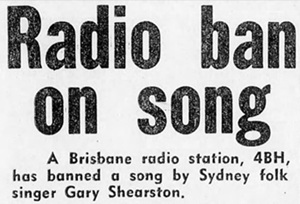
Hardy wrote the lyrics first then shared them with Shearston who worked them up further with whimsical references like Rinso: keep Australia white, linking White Australia immigration policies with a laundry detergent. That particular quip helped to get the song banned from Brisbane radio station 4BH.

Sydney Morning Herald 18 April 1965 [link]

Shearston must have been performing the song live before its release, because at least one verse on the recording had been suggested by an audience member. Hardy, apparently unimpressed, published his earlier lyrics in the folk magazine Australian Tradition as a song by Frank Hardy © Frank Hardy 1964, with the note This is the original version of Sydney Town as written by me. Folk singers and others who add new verses and variations do so at their own risk.

According to the liner notes to Shearston's 1965 album Australian Broadside, a friend of Hardy had given him a recording by a "calypso singer" of a song about the slums of Kingston town, the capital of Jamaica, and Hardy rewrote those lyrics for Sydney Town.

As an origin story for a song, this is unsatisfying. The liner notes, by academic and Shearston mentor Dr Edgar Waters, tell us nothing about the "calypso singer" or the original song, or its composer.

Nothing is clear. The word "recording" is ambiguous, as it could mean a released record or a private tape recording, and the song could have been an obscurity, orally transmitted with no known composer.

The trails have no doubt run cold, but I have been unable to find anything more about a calypso song, on or off record, that may or may not have been called Kingston Town. All in all, I'm inclined to treat the evidence for it as anecdotal.

And I can't help thinking about Frank Hardy, winner of Australia's 1967 Yarn Spinning Championship with 22 tall stories. Could he have been pulling someone's leg about a calypso singer and a song about Kingston, Jamaica?

US Copyright Office [link]

For more about the song's origins see Gary Shearston - Sydney Town.

01 May 2026

▶︎ Obscure Originators (39) Val Martinez

From my website's front page series about lesser known artists who performed the original versions of Australian or NZ records. 

See also: the full collection of over 40 Obscure Originators features. 

____________________


You Make Me Happy (1964) charted Top 20 in Sydney and Brisbane for that versatile entertainer and TV star Jimmy Hannan. So, a moderate hit but a good example of Australian diligence in finding material for cover versions.

The original was by Val Martinez, a B-side on RCA Victor (1963, wr. Jimmy Curtiss). He recorded four singles (1962-63) for RCA at its Hollywood studios with some of LA's top session musicians.

Martinez's RCA records have been well-reviewed, sometimes in retrospect (alas!). They have been taken up by some Northern Soul enthusiasts and dealers (again, too late!), and although that term is carelessly thrown about, it's not nothing.

Martinez was not a prolific recording artist. Apart from the four RCA singles, he had released four previous singles on three other labels, beginning with two on Cincinatti's King Records back in 1954. That appears to be the extent of his discography, but he was a well-booked club singer in Las Vegas and Hollywood and I'm guessing record sales were never his bread and butter.

____________________

In the 1920s and 30s another Val Martinez released many Spanish-language records and performed daily on Mexican border station XER. 

He was the father (1900-1943) of You Make Me Happy originator Val Martinez (1936-1998), and grandfather of the present-day Val Martinez who was once in a Four Seasons revival with Frankie Valli and now provides events and tuition through Val Martinez Music in Southern California.

I understand that the family tree goes back to yet another musical Val Martinez, the great-grandfather of the current Val Martinez, but that was beyond the reach of my research.

 ____________________

The Australians weren't the only ones to spot the potential of You Make Me Happy. After Jimmy Hannan's release in March 1964, at least three versions of the song came out in other countries later in the year, including one by Bruce Channel in the style of his hit Hey! Baby.


For more about the song and Val Martinez, see Jimmy Hannan - You Make Me Happy.


Val Martinez (USA 1963)


Jimmy Hannan (Australia 1964)


Bonus track: Bruce Channel (USA 1964) à la Hey! Baby

16 April 2026

▶︎ Obscure Originators (38) The Improper Bostonians


From my website's front page series about lesser known artists who performed the original versions of Australian or NZ records.

See also: the full collection of over 40 Obscure Originators features. 

____________________

Gee I’m Gonna Miss You (1968) was one of seven Australian singles released  1966-1971 by British-born Brisbane singer Graham Chapman. It topped the charts in Brisbane and made the Top 20 in Melbourne. 

Christchurch singer Marc Antony (stage name of Pat Kearns) released a further version in New Zealand (1969).

The original version was by The Improper Bostonians (1967). It was one of four singles they released 1966-67 on Minuteman, a small Boston label that was a subsidiary of a local entity called Columbus Records. It was also issued nationally on Coral, but it seems not to have done much business anywhere, on either label.

From NEMS (defunct site)

The Improper Bostonians were a quartet from Lynn in Greater Boston who had a residency at the Ebb Tide, a nightclub in nearby Revere Beach. 

Gee I'm Gonna Miss You was produced by Minuteman's owner Bill Walsh with Barry Richards, vice president of Minuteman and Walsh's co-producer on five of the eight Improper Bostonians tracks. It was written by Walsh too, with Joe Ahern, his collaborator on four of the band's six original tracks. Ahern still has five compositions registered at BMI under his full name Thomas J. Ahern (spelt Ahearn on the Coral single) but details are elusive.

The band's name would have been recognizable in Boston from Proper Bostonians, meaning the well-established upper-crust families of Boston, also known as Boston Brahmins (at Wikipedia, for example). There was even a book, The Proper Bostonians (1947), which explains, "Everywhere the Proper Bostonian goes in his city he is likely to find that the magic of the Family Name pronounced will open virtually all doors ..."

As for Improper Bostonians, that was probably an inevitable coinage, used whimsically or when reporting unruly behaviour from Bostonians. There was an Improper Bostonian room at Boston restaurant Your Father's Mustache in the 1960s, and a Boston lifestyle magazine The Improper Bostonian (1991-2019). Newspapers have used improper Bostonians when reporting on boisterous Red Sox supporters and over-enthusiastic fans of movie star Elizabeth Taylor.

____________________ 

For more about the song and The Improper Bostonians, see Graham Chapman - Gee I’m Gonna Miss You.


The Improper Bostonians (USA 1967)


Graham Chapman
(Australia 1968)

27 March 2026

▶︎ Obscure Originators (37) "Youth Opportunity Program” (Back To School)

From my website's front page series about lesser known artists who performed the original versions of Australian or NZ records.

See also: the full collection of over 40 Obscure Originators features. 

____________________

Of Hopes And Dreams And Tombstones was covered by The Purple Hearts, a respected Australian band with R&B-blues influences. It charted in Melbourne and Brisbane in 1966.

Australian listeners might have been surprised to learn that the original version was recorded as part of a 1965 US government campaign. The aim was to encourage teenagers to stay in school, unlike the singer who is working three jobs a day and regrets quitting school too early.

The Youth Opportunity Back-to-School Campaign distributed the single free to American radio stations with a formal message on the sleeve from Vice President Hubert H. Humphrey.

In spite of its origin, the record is a convincing piece of mid-60s popular music that was later adopted by Britain's Northern Soul movement. The vocals and the harmonica-led backing make it sound like a perfectly credible (even groovy!) rock record of the time.

 From 45cat.com's page about the release 

The title of the project is printed on the label instead of an artist's name, so the singer goes uncredited. He was Jimmy Fraser, still a mystery although I have seen it suggested that this was a pseudonym. Columbia Records did reissue the track commercially as a Jimmy Fraser single, but that was the last we heard of him, at least under that name.

Credit for the song's credibility goes also to the composer, Joy Byers. She wrote, for example, Eddie Cochran’s C’mon Everybody, several songs for Elvis Presley and (with co-writer Clyde Otis) Timi Yuro's What's A Matter Baby (Is It Hurting You).

In 2002 The Purple Hearts' Australian version provided the opening track and the title of one of Alex Palao's excellent Ace Records (UK) compilations, Of Hopes & Dreams & Tombstones (Beat 'n' R&B From Down Under). For me, that just about confirms the song's groovy status.

 ____________________

For more about the song and "Youth Opportunity Program” (Back To School), see The Purple Hearts - Of Hopes And Dreams And Tombstones.  

Not Col Joye! Columbia Records.


“Youth Opportunity Program” (Back To School) (USA 1965)


The Purple Hearts
(Australia 1966)

25 October 2025

▶︎ Obscure Originators (36) Willie Harper

From my website's front page series about lesser known artists who performed the original versions of Australian or NZ records.

See also: the full collection of over 
40 Obscure Originators features. 

____________________

Australian pop star Ray Brown released his version of New Kind Of Love in February 1967, the B-side of a double-sided hit with The Same Old Song (#12 Australia).

The original version of New Kind Of Love (1962) was one of several singles recorded by Willie Harper for the Alon and Sansu labels, both co-owned by Allen Toussaint, the major New Orleans producer, songwriter, arranger, singer and pianist. 

The consensus is that Willie Harper should have been better known. It's safe to say that more people have heard his voice than would know his name.

He was a constant presence in the background of Allen Toussaint's studio productions, and his own releases were typically written, produced or arranged by Toussaint. A Willie And Allen single from 1967 is by Harper and Toussaint.

Right at the start of Ernie K-Doe's recording of Toussaint's composition Mother-In-Law (1961 #1 USA, #8 Australia), you hear a deep voice repeating the single word Mother-in-law. That's Benny Spellman, but the voice that echoes him, there and throughout the song, is Willie Harper.


Breaking out in Chicago: Billboard 6 Jan 61

The composer of New Kind Of Love is Earl King, another multi-skilled New Orleans musician. Although the recording is admired by R&B and soul fans, it had only localised success at the time.

____________________

For more about the song and Willie Harper, see Ray Brown - New Kind Of Love. 

03 October 2025

▶︎ Obscure Originators (35) Johnny Yukon

From my website's front page series about lesser known artists who performed the original versions of Australian or NZ records.

See also: the full collection of 
over 40 Obscure Originators features. 

____________________

Johnny Yukon's real name was Ben Gabus. He was from Texas, born in Galveston in 1931, but later lived in Lafayette, Louisiana where he could be heard regularly at the Jury Room Lounge. His composition Ride Away (With A Song In Your Heart) was released by Slim Whitman in 1954.

As Johnny Yukon, Ben recorded his own composition Made To Be Loved (1959). It didn't make him famous, but it charted #25 in Italy, and it had a good run Down Under through local cover versions.

In 1960 it was recorded twice in Australia: by top Sydney deejay John Laws, and by a new young talent called Adam, an alias of Ian B. McLeod, the enduring country music artist, producer and record label owner from Warragamba NSW.

Neither of those records was a commercial success in Australia, but in New Zealand it was recorded by The Keil Isles, also in 1960. They were a popular Auckland rock'n'roll band formed by Samoan-born Olaf Keil and his cousin Freddie Keil with a line-up that included other members of the Keil family.

Chart placings are hard to pin down for New Zealand in the 1960s, but Warwick Freeman's retrospective chart places The Keil Isles' version of Made To Be Loved at #2 New Zealand.

Ben Gabus released Made To Be Loved again in 1964, this time as Ben Gabus. This is sometimes mistaken for the original version, partly because of confusion between two record labels with the same name and catalogue numbers.

In his later years Ben lived in Lexington, South Carolina and ran the Ben Gabus Tree Service. 

____________________

For more about the song and Johnny Yukon, see The Keil Isles - Made To Be Loved. 

22 August 2025

▶︎ Obscure Originators (34) The London Knights [The Four Sights]

From my website's front page series about lesser known artists who performed the original versions of Australian or NZ records.

See also: the full collection of 
over 40 Obscure Originators features.

 ____________________

Go To Him by Ray Brown & The Whispers (1965) may be the B-side of their hit Fool, Fool, Fool (#3 Australia), but a B-side like this was a bonus for anyone who bought the single.

Retrospectively, Go to Him has taken on a life of its own. As the Milesago website puts it, Ray Brown & The Whispers’ track is 2m 30s of pure sonic adventure, one of those rare and extraordinary B-sides that almost eclipses the main event … Alec Palao included it on the Ace Records/Big Beat collection Hot Generation! 1960s Punk from Down Under (2002).

Tracing the original of Go To Him, I found a 1965 American release by The London Knights on minor New York label Mike, about three months before Ray Brown’s cover. 

I tried to find out more about The London Knights. They had released only this single and they left no traces of their history that I could find.

Web searches unexpectedly led me to the website of a British musician, Tim Airey. He had been in a 1960s Leicester band, The Four Sights, aka The Foursights. 

Tim recalled two Four Sights recording sessions for Decca in London in 1963. The band released one unsuccessful single, and there were songs for another single that was never released in the UK.  However, as Tim explained, … [the single] was supposed to have been released in the States under the name of The London Knights … 

The Four Sights then heard nothing more about any American release.

Well, not until some 40 years later when I emailed Tim in 2003 to point out that there was indeed a London Knights US single, from 1965, with a track called Go To Him that credited Bess Coleman as co-writer.  

Bess was a sister of Four Sights guitarist Bill Coleman, and she had written both sides of the Four Sights’ Decca release.

When I sent an mp3 of the London Knights recording to Tim he was adamant that it was one of the lost tracks from the Four Sights’ London sessions. He identified the distinctive voice of Four Sights drummer and lead singer David Lindsay, and David himself subsequently had no doubt at all that he was listening to his own voice on the London Knights track. David later sent me further evidence that supported this.

The case made by Tim and David was compelling, and I had no reason to doubt them, but I still could not explain some aspects of the "London Knights" single.

The writer credits on the label are to Bess Coleman with Artie Wayne, Bess's American collaborator whom she met in the US early in 1964. Bess is also credited as producer, for Artie’s production entity AWK.

When I asked Artie about it, he recalled recording Go To Him in New York as The London Knights with Bess and her brother Bill Coleman from the Four Sights, and I assume the label credits on the Mike single mistakenly reflect that session.

The mystery remains around the exact pathway of Go To Him from the Four Sights in London to Mike Records in New York, with an unreleased re-recording along the way. My best guess is that there were two recordings, one from London and one from New York, and they were somehow mixed up at the New York end.

You can read the rest of what I know by clicking on the link below. Or you could just mentally file it under O for Obsessive Fans of Obscurity and move on.

____________________

For more about the song and The London Knights [The Four Sights] see Ray Brown & The Whispers - Go To Him. 

13 June 2025

▶︎ Obscure Originators (33) Bobbie & Dude

From my website's front page series about lesser known artists who performed the original versions of Australian or NZ records.

See also: the full collection of 
over 40 Obscure Originators features. 

____________________

Country and pop singer Maria Dallas was a star in New Zealand. Her first single Tumblin' Down (1966, #11 NZ) won the prestigious Loxene Golden Disc Award, but her most successful single in NZ was Pinocchio (1970, #1), her fifth to chart Top 30 there.

In Australia, though, Maria's biggest hit was with Ambush (1967, #16), recorded in Nashville where she went after working in Australia for a while. The song stood out for its unforgettable rhythmic line at the end of verse and chorus: Your kissin’ leavin’ good-time days are dead. It was later recorded by Teresa Brewer (1975) and by Australian country artist Craig Giles (1993), but Maria's was the original release.

Ambush had been copyrighted a few months earlier by its composers, two sisters from the small Texas town of Moody, near Waco. As it happens, Maria Dallas was also from a small town, Morrinsville in New Zealand.

Bobbie Jo and Elizabeth Ann Brown had been singing from an early age in The Brown Sisters, a solidly booked country-gospel trio with another sister, Bettie.

Montreal, 1967
By the time of Ambush they were a duo called Bobbie & Dude. The stage name Dude was adopted by Elizabeth because it seemed to go better with Bobbie. They toured widely, and performed during Expo ’67 in Montreal where their only single had some radio airplay. As far as I can see they did not record Ambush themselves.

For a long time I knew almost nothing about Bobbie & Dude apart from their writing credits for Ambush and a few other songs. I was puzzled by the addition of Elizabeth Ann Brown to co-writer Dude Brown's name in Ambush's copyright registration, but I had never thought of searching for "bobbie and dude" in quotes.

As I have often typed here, Eventually, someone emails. This time it was someone who knew Elizabeth Ann well, and their tantalisingly brief words gave me the clues I needed.

____________________

For more about the song and Bobbie & Dude see Maria Dallas - Ambush. 

23 April 2025

▶︎ Obscure Originators (32) The Meantime

From my website's front page series about lesser known artists who performed the original versions of Australian or NZ records.

See also: the full collection of 
over 40 Obscure Originators features.

____________________

Johnny Farnham's cover version of Friday Kind Of Monday (1968) was a hit in Australia (#6) and New Zealand (#11).

The original version from 1967 was by The Meantime, a group that came out of nowhere, released this one single that failed to chart Top 100, and that was it.

This looks like a clear case of obscurity until you follow the lead in the writer credits. Friday Kind Of Monday was written by Jeff Barry and Ellie Greenwich, one of the most successful songwriting teams of the 1960s, and a married couple from 1962 to 1965. 

As Billboard announced (above), the lead singer on the Meantime single is Ellie Greenwich but, more than that, the whole recording is a studio project by Greenwich and Barry.

They had previously written and recorded as The Raindrops whose seven singles 1963-65 included He's The Kind Of Boy You Can't Forget (1963 #17 Bb, #15 CB) and What A Guy (1963 #34 CB). They charted moderately in most Australian cities, but in Adelaide they had hits with Kind Of Boy (#4), and That Boy John (1963, #12).

When you listen to a Raindrops record, you are most likely hearing Greenwich's voice double-tracked, with Barry's bass vocals and prominent drumming. For live appearances and for photos of a trio, other personnel were recruited.

The Meantime was a similar project, a Raindrops for the late 60s, created in the studio by Barry and Greenwich. (There is a cryptic clue in the group's name: think Greenwich Mean Time.)

All of this reminds me of Leiber and Stoller's view that We don't write songs. We write records.

____________________

For more about the song and The Meantime see Johnny Farnham - Friday Kind Of Monday. 

23 January 2025

▶︎ Obscure Originators (31) The Fun And Games

From my website's front page series about lesser known artists who performed the original versions of Australian or NZ records.

See also: the full collection of 
over 40 Obscure Originators features.


The Grooviest Girl In The World
was a #3 New Zealand hit in 1969 for Hutt Valley band The Simple Image.

The original version was released in the US in 1968 by The Fun And Games, a six-piece band from Texas with four members who had been band-mates since their high school years in Houston. They included the Romano brothers, Joe and Rock, who both went on to successful careers in various branches of the arts (there is a Wikipedia page about Rock).

The Fun And Games 1969 [link]
The Fun And Games version of The Grooviest Girl In The World was produced by one of its writers, Gary Zekley. He is partly known for singing, co-writing and producing on the single Yellow Balloon (1967 #25 USA) and the subsequent album by The Yellow Balloon. These later became artifacts of the retrospectively named genre of Sunshine Pop. 

The Simple Image were one of those fine New Zealand bands of the 60s-70s that topped the charts in New Zealand with records that were unfamiliar to most Australians. NZ artists such as The Simple Image, The Dedikation, The Avengers, and The Fourmyula had #1 or #2 NZ hits that never surfaced in Australia.

There's a twist to the story of The Grooviest Girl In The World that I discovered later. Although most Australians would not be able to hum the tune for you, a Boomer from South Australia might know it. The original version by The Fun And Games charted in Adelaide March-May 1969, peaking at #3. (That averages out to #72 Australia; in the US it reached #78 Billboard.) This is a surprising outlier which I suspect is down to radio airplay on Adelaide's 5AD. 

____________________

For more about the song and The Fun And Games see The Simple Image - The Grooviest Girl In The World. 

28 December 2024

▶︎ Obscure Originators (30) Bob Wilson

From my website's front page series about lesser known artists who performed the original versions of Australian or NZ records.

See also: the full collection of 
over 40 Obscure Originators features.


In 1960 Bob Wilson released the original version of (And Her Name Is) Scarlet. A later version by The De Kroo Brothers was a #9 Australian hit in 1963

Bob Wilson's recording came out on LA label Era. It was written by Steven Howard, a pseudonym of Era's co-founder and owner Herb Newman (1925-1976). He had co-written The Wayward Wind, a hit for Gogi Grant on an Era single (1956, #1 USA).

Before The De Kroo Brothers got to it, Keith Colley had recorded Scarlet, again on Era (1962), and there had been a German version in 1961.

See full news item
This was interesting, and not hard to find out, but who was Bob Wilson? The trouble is that the world is full of Bob Wilsons, so his identity was infuriatingly difficult to search for. I discovered that even BMI, the US copyrighting outfit, had registered compositions by at least three different Bob Wilsons together under one name.

Eventually, someone emails. This time, it was a longstanding friend of Wilson who had much information about his life and career. Thanks to him and some further digging, I was even able to create a passable Bob Wilson article at Wikipedia.

This Bob Wilson was a guitar virtuoso and singer-songwriter from Pleasant Hill, California. As a teenager just out of high school he recorded some singles on Era, then had a long career as a schoolteacher with occasional reappearances on record.

For example, he featured on an album by folk artist Janet Smith in 1968, and he released albums with Rick Shubb (the Shubb Capo inventor) in 1976 and 1999. In the mid-2010s his Bob Wilson Ensemble appeared at the California Academy of Sciences in San Francisco. 

____________________

For more about the song and Bob Wilson see The De Kroo Brothers - (And Her Name Is) Scarlet.


03 December 2024

▶︎ Obscure Originators (29) Drafi Deutscher And His Magics

From my website's front page series about lesser known artists who performed the original versions of Australian or NZ records.

See also: the full collection of 
over 40 Obscure Originators features.

In 1960s Germany, singer-songwriter Drafi Deutscher was a chart-topping pop star, but to most  Australian pop fans at the time his name would have been, well, obscure.

Johnny Chester's moderate hit Teeny (1963 #28 Australia), with English lyrics by Johnny himself, is a cover version of Teeny by Drafi Deutscher And His Magics.

More than that, Johnny is singing over the backing track recorded for Drafi’s single, and he repeats the procedure on the B-side with Do The Stomp, a cover of Drafi’s B-side Shu-bi-du-bi-do The Slop, again with Drafi's recycled backing track.

The following year, W&G did this again when Merv Benton sang new lyrics by Noel Watson over the backing tracks from both sides of Drafi's single Shake Hands / Come On, Let’s Go.

English translations or rewrites of songs are not unusual. The lady in Mark Holden's I Wanna Make You My Lady (1976) was an angel in the original Swedish hit Jag Ska Fånga En Ängel. You're My World came from Il Mio Mondo, and My Way came from Comme d'habitude.

The idea of recording vocals over the backing track of an original version is not unheard of either. Six months before Johnny Chester's Teeny, Ben E. King's 1963 hit I (Who Have Nothing) had used the backing track from Uno Dei Tanti (1961), the original version by Joe Sentieri.
Other double-sided covers exist, too. In 1957 The Diamonds covered both sides of The Rays’ single Silhouettes / Daddy Cool, and in 1964 Australian band The Cicadas covered both sides of The Marauders' British single That’s What I Want / Hey Wha’ D’Ya Say with some regional chart success.
But W&G's twofold use of the manoeuvre I like to call the double-sided cover version with English adaptation and recycled backing track must be unique.
___________________
For more about the songs and Drafi Deutscher And His Magics see Johnny Chester - Teeny and Merv Benton - Be Sweet.