04 February 2023

▶︎ The greatest song in the universe?

This is the greatest song in the universe, our youngest son recently said to me in a dream, and I awoke with the song still playing in my head. 

You can allow some hyperbole in a dream, but it was Bryan Ferry's Don't Stop The Dance, and there are days when I do believe it is the greatest song in the universe. 

In the late 1980s when I was almost 40, two university students used to babysit for us. Rosie had worked with me as a student teacher in my classroom, and her friend Sam turned out to be our neighbour's boarder. Rosie was a serious Beatles fan, at a time when a student was more likely to be a fan of… what? Michael Bolton? Bros?

One winter vacation they asked us to babysit their children (as they said), and they lugged over some crates of their most cherished vinyl LPs. They were worried about burglars making off with them while they were away. 

Big responsibility, but I was welcome to listen to them. It was clear that, as well as the Beatles, Rosie was into Bryan Ferry and Roxy Music

These albums were a revelation. I mainly knew them through hits like Love Is The Drug (Roxy, 1975), and Ferry's retro-remakes Let's Stick Together and The Price of Love (1976), but I'd never explored them properly. 

The stand-outs for me were Roxy's Flesh And Blood (1980) and Ferry's Boys and Girls (1985). Tracks like Slave To Love, Don't Stop The Dance, and Flesh And Blood, with their layers of instruments and inventive arrangements, felt close to a multi-sensory experience.

Although Don't Stop The Dance appeared in a dream as the greatest song in the universe, recording or track or might be more accurate. I'm not surprised that there are few covers of the song, because its attraction seems inseparable from the production.1

When we say we love a song, we often mean we love a recording, whether it's an original version or an inspired remake. That's been true ever since a hit song stopped being measured in sheet music sales.  When I say I love Be My Baby I mean that extraordinary artefact from 1963, the recording by The Ronettes, not the unadorned melody and lyrics. 

The great pop producers of the 50s and 60s, people like Bob Crewe, Phil Spector and Brian Wilson, understood that it was the recording, that unique one-off artefact, that was important.2 

Spector had a genius for an arranger, Jack Nitzsche, who is usually overlooked by the average listener, but in a way Spector's name was shorthand for a collaborative enterprise that included songwriters, arrangers, session musicians, producers, engineers as well as the upfront talent. 

It's extraordinary that I still listen to Don't Stop The Dance at least once a week some 35 years later, and hard to imagine that the five- and six-year-olds I was teaching at that time would have turned 40 themselves last year.

---

1. Ferry himself may have been following this line of thought when he remade Don't Stop The Dance in an instrumental trad jazz arrangement on The Jazz Age (The Bryan Ferry Orchestra, 2012). He was "fascinated to see how [the songs] would stand up without singing" (interview in Daily Telegraph, quoted at Wikipedia).

2. Michael Campbell & James Brody cite songwriter-producers Jerry Leiber and Mike Stoller: "We don't write songs, we write records." (Rock and Roll: An Introduction, course notes, University of Minnesota, 1999, 2008.)


01 February 2023

▶︎ Disappearing acts

The other day some bloke tweeted, "Anyone remember Dionne Warwick?"

Dionne Warwick answered, "Doesn't ring a bell."

When I wrote about a Top 20 hit by Sydney singer Jennifer Ryall I said that she was "lost to history". I hadn't been able to find out much about her, and there was nothing after the mid-1970s. 

Jennifer Ryall
Jennifer Ryall finally emailed to tell me she wasn't lost, and her own history turned out to be rich and varied. In the following days she gave me a lot of information, full of interest, which I used to write up a decent account of her career. 

I now avoid suggesting that people are lost, or that they disappeared or vanished, just because they haven't released any music for a while. 

It's a trap that fans can easily fall into. When a performer we know only through their media persona stops performing, there is a sense that they have literally disappeared. 

We might even sympathise with them for their downfall, even if we have no idea what they are doing these days. However fulfilling their life away from the music (or film or TV) business might be, their absence suggests that they no longer do anything. They exist for us on the public stage and when they've gone it's as if they don't exist. 

The jazz trumpeter, composer and bandleader Red Perksey migrated to Sydney via France in 1951. He soon established himself on radio and records, and in live gigs, and he became Musical Director for a Sydney record company. 

Red and his orchestra had a hit with (A Little Boy Called) Smiley from the film Smiley Gets A Gun (1958), and they backed Vic Sabrino on his version of Rock Around The Clock (1955), a record some call as the first Australian rock'n'roll record. He was clearly a bright and likeable personality who pops up here and there in the newspaper archives. 

Red Perksey 1950s
In 1958 he was photographed joshing around poolside at a deejays' convention, and he was giving lunchtime concerts at a Sydney music store. 

Then there is nothing. No more listings in the radio guides, no more gigs advertised, no more affectionate write-ups. He disappeared?

I had written what I believed was the definitive biographical sketch of Red Perksey. He was born Siegbert Perlstein in Berlin in 1921, of Jewish German-Polish background. I traced his progress from Berlin in the 30s, to Palestine in the mid-40s and Paris in the late 40s. He and his wife Zizi came to Australia by refugee ship in the early 50s, and were later naturalised here. The only later date I had was his death, in 1995, but from 1958 until then, nothing. 

Eventually, someone emails. A niece, his closest living relative, emailed from Paris with some answers. 

To Australian audiences, to the Sydney newspapers, and (retrospectively) to this archival forager, Red Perksey had disappeared. 

Meanwhile, a couple known as Bert and Anne were living in a remote French village where Bert painted, sculpted and made furniture. They grew vegetables and spoke to their dog Lassie only in English. Bert was also a musician, and sometimes he joined in with local groups.

To us, they had disappeared; in France, Red Perksey and his wife were in plain view to their fellow villagers. 

I guess my point is, there are more places in this world than the public stage. 


Links

• My series Obscure Originators collects pieces about lesser-known artists who recorded a song that was later covered in Australia. Most of them fit into the theme of this post.

• Dionne Warwick's tweet 30 January 2023

Full stories at my website:

• Jennifer Ryall - Everything’s Alright (1972)

• Red Perksey & His Orchestra - (A Little Boy Called) Smiley (1956)

Images: Jennifer Thomson, Mia Cahen, with thanks.


Update: Thanks to Jamie for alerting me to a parallel in novelist Thomas Pynchon who has intentionally disappeared himself from public scrutiny. He carries on an unremarkable life in a Manhattan neighbourhood and dismisses the idea that he is reclusive. Pynchon told CNN he believes recluse is a "code word generated by journalists... meaning, 'doesn't like to talk to reporters.'" (linked from Wikipedia).


22 December 2022

▶︎ When did that record come out?

Billboard singles reviews: useful for locating a record in time

1. Why

Knowing the absolute original version of a song is probably not important to many music fans. Blue Suede Shoes is an Elvis Presley song, and the fact that it was first recorded by Carl Perkins is of limited interest.

Similarly, unless they are pub trivia enthusiasts it is also enough for most listeners to know roughly which year a record was released. Give or take a year or two is probably good enough for historic or nostalgic context. Even, say, late 60s or mid-70s will do.

Some of us, though, cannot rest until we know who first performed or recorded a song. The sport of tracking down original versions often demands more than the year a record came out. We might need the month, or the week, or (surely not!) the day a record was released. 

Part of the urge is worthy, to give credit where it's due, credit to the original composers, arrangers and artists. I can't deny there is also the satisfaction of being the smart alec who has knowledge that everyone else has missed. 

At the back of the mind, too, is the hope that the undiscovered original version will turn out to be the best, an authentic gem that reveals the raw vision of the creator, unspoilt by the tinkering of the cover versions. That happens, but it often turns out to be the opposite, when the cover version has added something to the original work, even revealed something about it. 

As with fanatics of any sport, though, it is hard to explain to an outsider why we are so caught up in it. We keep looking, digging around the archives until we find even a tiny clue. Because the data is limited, though, you might still be left with an approximation or just circumstantial evidence.

- - -

2. When did my canary get circles under his eyes?

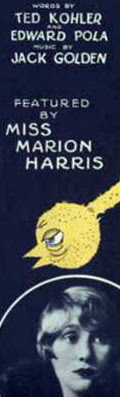
Sheet music (clip)
My Canary Has Circles Under His Eyes became known in Australia through the 1973 version by Captain Matchbox Whoopee Band which charted moderately around the country. 

It first appeared in 1931. Most sources will tell you that British bandleader Debroy Somers released the original version, but I believe the British release by American singer Marion Harris has a good claim to being the original. 

I can't prove it, and the evidence is limited and partly circumstantial, but the case for Marion Harris is enough to avoid calling either as the original release.

Both records came out in the period April-May 1931, so my aim was to narrow it down:

• In the limited number of British newspaper mentions of the records, only Marion Harris appears in April, and there are no mentions of Debroy Somers until May. (The flaw: I don't have access to the archives of every newspaper in the universe.) 

Jack Golden
• Composer Jack Golden had previously been accompanist to Harris, which may explain her early access to the song. It might even have been exclusive to her for a while before any records came out. (The flaw: circumstantial, not proof.)

• Harris appears on the cover of the sheet music. (The flaw: it's common but not necessary that the sheet music carries the song's originator.)

In the meantime, I did find evidence of Marion Harris performing Canary on stage and radio in the US in January 1931. After that there are no other mentions of the song in the news archives until April 1931 when Harris's record is mentioned. For the rest of 1931 the song title often pops up in various contexts. This was enough for me to call Harris as having the Original version: live performance, at least until contradictory evidence comes up. 

As I always say about the website, Eventually, someone emails. The page will stand until then. Or until someone comments here, I guess. It does happen.

- - -

3. Where do I find out? 

Steven C. Barr dates the 78s   
 
• 45s and EPs: 45cat.com.  and for other formats e.g. albums and 78s: 45worlds.com
 
• All formats but best for albums: Discogs.com

• Huge music magazine archive at World Radio History.

• Newspaper and magazine archives: Trove (Australia), Gale (mainly British), and Newspapers.com and NewspaperArchives.com (mainly USA, paid subs).

• Archived books and magazines at Internet Archive. Just search.

• Discographies by e.g Steven C. Barr (The Almost Complete 78 rpm Record Dating Guide), Martin C. Strong (The Essential Rock Discography), or Brian Rust (many, including The complete entertainment discography, from the mid-1890s to 1942). 
 
The Originals book in English (link)
 
• Biggest and best original version sites: The Originals, Cover.info, and Secondhand Songs.

• 78s: Online Discographical Project (78discography.com) for recording dates (not release dates)

Sometimes naming a release date is down to speculation, or even an informed hunch. You might have to declare it a draw and let it rest. Disappointing, but we are working with imperfect data.

- - -

Some of this appears in a different form at the About page of my site Where did they get that song? and at my page about My Canary Has Circles Under His Eyes.  

29 June 2022

▶︎ Just Out of Reach: The Stewart Family on KLCN Blytheville

"Just Out Of Reach (Of My Two Open Arms)" by The Stewart Family was the original version of the song. Written by V.F. 'Pappy' Stewart, it was released in 1951 on Bill McCall’s Los Angeles label Gilt-Edge. The group also had records issued on affiliated label 4 Star.

Dozens of other versions of the song, many by major artists, have been released since early cover versions by Faron Young (1952, B-side on Capitol) and by Bonnie Lou (1953, B-side on King). The Originals website lists a selection of 15 versions, and Cover.info lists 55.

Bunny Walters charted #21 in New Zealand with his version in 1970, hence my interest in it.

Pappy Stewart in 1976 (local news story).


The Stewart Family
was a real family, a country and gospel group led by Virgil F. “Pappy” Stewart (1907-1988), a Blytheville, Arkansas soybean grower and the composer of Just Out Of Reach, .

The Stewarts were one of several family musical groups in the area at this time. They were part of a thriving country, hillbilly and gospel music scene nurtured in the 1930s and 40s by local radio stations like KLCN in Blytheville and KOSE in nearby Osceola. 

In 1970, Blytheville journalist Jim Branum noted that KLCN has done as much for country artists than any other station its size in the nation, and acknowledged the prevalence of family groups amongst hillbilly artists.

The Stewart family worked a farm, but they were also musicians, and they married musicians, and they had neighbours who were musicians. The names of Stewart family and friends appear in the line-ups of multiple groups on local radio, and at local events like the National Cotton Picking Contest. 

Some of these artists cut some records on minor labels, but Pappy Stewart’s extraordinary success with Just Out Of Reach, and his connection with the music stars who recorded it, is an outlier in a mainly localised industry.

Pappy, his two daughters, and his sister appeared regularly on KLCN Blytheville from 1934 after they convinced the station to give them a regular 15-minute segment. They toured extensively around the region until 1953. The band broke up as the daughters began raising families of their own.

The family was billed at local events as Pappy Stewart’s Family or Pappy Stewart And His Famous Family. For a gig in Charleston, Missouri in October 1945 they were advertised as “Pap Stewart And His Arkansas Cowgirls of Radio Station KLCN, Blytheville.

In 1951 the line-up was Pappy Stewart (guitar), his daughters Bethyl (fiddle and vocals) and Janet (bass violin), his multi-instrumental sister Baba Howard (mainly accordion) and Bethyl’s husband Buddy Brown.

Baba had also been heard on KLCN in Don & Baba Howard & Their Smiling Hillbillies (clearly along similar lines to Don Howard and His Smiling Hillbilly Gang and Donald Howard and His Smiling Hillbillies, also spotted in the archives).

Also touring with the Stewarts during this period were Wilma Scott and Don Whitney.

Wilma Scott was from Blytheville too, and had been in the Burdette Girls Quartet with Bethyl, Janet and Baba Stewart in the early 1940s. Don Whitney (1926-1985), from nearby Osceola, also worked solo, on stage as Arkansas’ Biggest Hillbilly and on several discs on the 4 Star label. He was a disc jockey at KLCN Blythedale and at KOSE Osceola where he became general manager.

Apart from Just Out Of Reach, Pappy Stewart was a prolific songwriter who had a number of other songs recorded by other artists including Patsy Cline. Many of the songs in the family’s repertoire were written by Pappy or his sister Baba.

When interviewed in 1976 for a profile in Blytheville’s Courier-News, Pappy Stewart was 68 years old and had been married to Gladys for 50 years. He was long retired from professional music and happily living and working on his farm. His sister Baba, who was much younger than Pappy, died in Blythedale in 2013, aged 87.

I’m just a country boy. I’d rather farm as do anything. I’m doing what I want to do.

Pappy Stewart to Jack Weatherly, The Courier-News, 1976


National Cotton Picking Contest 1949
 
This content was first published at my website in my history of Just Out Of Reach. See there for selected sources.