22 April 2006

▶︎ More on Andy Kirk and Killer Diller

In the late 30s when the yet-to-be-famous saxophonist Charlie Parker was fired from Jay McShann's band, on the road in Detroit, it was Andy Kirk who drove him back to New York.

That's in the book of the Ken Burns TV series Jazz. It also has a large photo of Andy Kirk's band The Twelve Clouds Of Joy. Andy Kirk is mentioned in passing, and quoted on the Kansas City scene, but more attention is given to his pianist, composer and arranger Mary Lou Williams: there is a Mary Lou Williams page at the Jazz website at PBS.

In fact, where Andy Kirk is concerned, all roads lead to Mary Lou Williams. ASV's retrospective CD Andy Kirk& the Twelve Clouds of Joy with Mary Lou Williams has 19 MLW compositions written for Kirk's orchestra, including Mess-A-Stomp, Walkin' and Swingin', In The Groove and Lotta Sax Appeal. [Amazon link]


Phil Milstein emailed to say that the George Wiltshire in the credits of Killer Diller is probably George "Teacho" Wiltshire, the musician, producer, arranger and actor whose career crossed decades and musical genres. He worked, in one capacity or another, with Louis Jordan, Thelonious Monk, Gene Pitney and The Drifters. He was a mentor to singer-songwriter Toni Wine, led an orchestra for a song-poem label, and guested in an episode of Sanford & Son. See, for example, Phil X Milstein's American Song-Poem Music Archive, and Toni Wine's website on her meeting with Teacho Wiltshire when she was an ambitious teenager.

Also, on the subject of the Katherine Dunham School of Dancing, Dave Heasman left a comment saying that Eartha Kitt was in Katherine Dunham's troupe for a while. She would've joined circa 1943, if my math is accurate, and toured the world: I doubt that she would've been one of the Varietiettes, but it's an interesting connection.

See my previous post: Andy Kirk, his Orchestra and other delights.

13 April 2006

▶︎ Andy Kirk, his Orchestra and other delights


Post updated 2022, 2025 with new information and YouTube videos.
_______
 
I found Andy Kirk and his Orchestra on a DVD of Killer Diller (1948). It was in one of those cheapo mega DVD packs from the supermarket, 50 movies for $29.95.  
 
Update 2025: the full movie is at YouTube (of course it is!).

Killer Diller is a vehicle for a number of black music and vaudeville artists. The best known names in the credits might be Nat 'King' Cole, Jackie 'Moms' Mabley (she often guested on TV in the 60s) and Butterfly McQueen of Gone With The Wind fame.

It's a farce set in a variety theatre, I guess in Harlem, starring Dusty 'Open The Door Richard' Fletcher as an incompetent magician who keeps losing people in his magic wardrobes. There's a backstage romance, a bunch of bumbling cops, and lots of knockabout humour and corny jokes.
(- Where'd he go? - Down there. - How do you know? - I seen this movie before.)

Maybe you had to be there, but from this distance it looks creaky. There are compensations, though, including lindy hopping by The Congaroo Dancers and a smooth, good-humoured set by the King Cole Trio, beginning with "Ooh Kickaroonie".

Andy Kirk, tall and suave, comperes the variety show that's going on while the story gets out of control backstage, and the Andy Kirk Orchestra makes three appearances. The first ("Gator Serenade"?), is a locomotive, rhythmic piece that builds, showcasing the saxophonists Ray Abrams and Shirley Greene

Later there are some comic bits after Abrams finishes a fine solo standing front-of-stage with Kirk and Greene and returns to the ranks of the band. He repeatedly tries to rejoin Kirk and the spotlighted players out front, and is repeatedly sent back to his place by the boss, crestfallen.

This really swings: dare I say, it rocks? This is 1948, and all around us are the influences on rock'roll, itself just a hop, step and a jump away.

When I'm listening in this period, late 40s, early 50s, I'm like a kid camping out at night, listening for sounds in the forest. Every now and then I'll sit up, straining to hear: "Did I just hear some rock'n'roll? Off in the distance, really faint... There it is again..!"
 
Electric guitar makes you think of rock'n'roll, but by this time it wasn't unknown in jazz, and it features in the next Andy Kirk piece ("Basie Boogie"?). There's a touch of bebop about this, it's not pure bop, but it  bops all right. 

Alerted by the YouTube comments thread, I'm now convinced that the guitarist is René Hall (1912-1988). His later body of work with rock and soul artists during the 50s and 60s is impressive. [Update Aug 2022]

Andy Kirk closes the film by announcing the dancing girls. These are The Varietiettes and they are cool: they file on in short swishy skirts and perky little hats, and they do a fairly synchronised, shuffly kind of dance with waving arms and twisty stuff, a few kicks and jumps, no fancy steps, nothing too frantic. Meanwhile, Andy & the boys try to focus on a peppy dance tune with lead guitar.


The effect is unlike anything I've seen before. There's something reserved about the girls' demeanor, as though they're concentrating hard, and the musicians seem to be sharing a series of private jokes with each other. All the time there's this maddeningly catchy jump dance tune chugging along.

I hadn't heard of Andy Kirk (1898-1992), and he wasn't in any of my standard reference books (which just shows up the limitations of my jazz reference library). Turns out he was a key figure in the Kansas City jazz scene from the late 20s, with his band The Twelve Clouds of Joy.

The consensus seems to be that he was over-shadowed by such Kansas City stars as Count Basie and Benny Moten, but that he was a real contributor to the genre as a bandleader. His line-ups over the years included tenor saxophonist Dick Wilson, vocalist Pha Terrell and trumpeter Fats Navarro (none of whom are seen in Killer Diller). Even Charlie Parker was with him for a while.

In fact, these days he is usually mentioned in biographies of Mary Lou Williams, the esteemed pianist, composer and arranger who was with Andy Kirk from 1929 till 1942. Look her up: she was a star in her own right, who wrote and arranged for Benny Goodman and Duke Ellington. The Mary Lou Williams Online Exhibit includes many fine photographs of her Andy Kirk days.

The Andy Kirk theme (all bands had a theme), sung by Pha Terrell, was Until The Real Thing Comes Along (1936), first recorded in '33 by Ethel Waters and also known in Fats Waller's throwaway version.

By 1948, when Killer Diller was made, the band was no longer The Twelve Clouds of Joy, Mary Lou Williams had left (there's a young guy on piano), and Andy Kirk was about to leave full-time bandleading. There's a New York Times report, archived online, about a 1982 tribute attended by Kirk, "tall, trim and vigorous" at 84. In 1989 Kirk's memoir Twenty Years On Wheels was published by University of Michigan Press.

And the Varietiettes? It crossed my mind that they might've been girlfriends of the band, recruited at the last moment, but that was unkind. They're billed as being from the Katherine Dunham School of Dancing. Katherine Dunham was a progressive and influential figure in modern black dance. For a start, see the Katherine Dunham Collection at the Library of Congress, but a Google search for "katherine dunham" + dancing gave me 110,000 results.

[See follow-up posts here and here.]
---
Note on guitarist Floyd Smith (August 2022): When I wrote this post in 2006 I speculated that the guitarist seen with Andy Kirk might have been Floyd Smith. It looks as if it is in fact René Hall. It's worth noting though, that Smith, who was in Kirk's band into the late 40s, was a pioneer in helping to bring the electric guitar into jazz in the late 30s. For example, here's the All About Jazz website [archived] commenting on Charlie Christian: 1939... Charlie probably learned of the electric from Floyd Smith whose "Floyd's Guitar Blues" made with Andy Kirk's Clouds of Joy is the first important use of the electric guitar. The electric guitar was almost unknown before this.
---
Update 2025: Rereading this post years later, I find that my identification of the musical tracks was a bit shaky. I have deleted one title and added question marks to two others. I have added a clip from the film below, Apollo Groove according to the YouTube post.
 
Further reading: Commentary on Killer Diller posted in 2020 at the Monster Movie Blog. 
 

10 April 2006

▶︎ Timeouts: The Tornadoes and a Marching Band

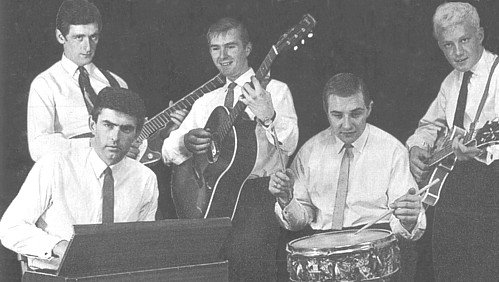
Gregg Sinclair who - as I mentioned previously - was a panel operator at 2GB, emailed with two more examples of Timeout Instrumentals: Lapland by The Baltimore & Ohio Marching Band (1967) and Hot Pot by The Tornados (1964).

Lapland is one of those obscure instrumentals that was surprisingly popular in Australia. In early 1968, it reached #5 in Sydney, #20 Melbourne, #9 Brisbane, #20 Adelaide. It didn't register nationally in the US, but charted regionally.

As for The Tornados: I can't believe I overlooked them, as they would've been a rich source of Timeout Instrumentals. They had that one stunning worldwide hit with Telstar (1962), produced by Joe Meek who also wrote a lot of their tracks, and they continued with a series of organ-led instros. These were pleasant enough but not in the same class as Telstar, and tended to sneak into the lukewarm end of the hottest hits.

Globetrotter (1962), Robot (1963), Dragonfly (1963), Monte Carlo (1964), Hot Pot (1964) and Exodus (1964) all charted somewhere in Australia - though not spectacularly - and I remember The Ice Cream Man getting some airplay as well. One thing Aussies dug in those days was an instrumental.


The Tornados. Bassist Heinz Burt (far right) had some
vocal hits as 'Heinz', notably Just Like Eddie (1963)

08 April 2006

▶︎ Timeout Instrumental hits

In the previous post, I noted that Timeout Instrumentals weren't usually hits, and often came from from LPs, EPs and B-sides.

In a comment below, John G. suggested one exception, Love Is Blue (L'amour est bleu) by French orchestra leader Paul Mauriat (#1 USA, #12 UK, #1 Australia, #4 NZ). It was written by Andre Popp, initially as a 1967 Eurovision Song Contest entry sung by Vicky Leandros with lyrics by Pierre Cour. 

 No Matter What Shape (Your Stomach's In) by The T-bones (1966), and Classical Gas by Mason Williams (1968) were both hits (Classical Gas even has its own website), but I'd be surprised if they weren't also used as Timeout Instrumentals.  

Another example, and a mystery, is The Harem by British clarinettist and bandleader Mr Acker Bilk (right) and his Paramount Jazz Band. It was a hit in Australia in 1964 (#2 Melbourne, #4 Sydney, #3 Adelaide) but failed to chart in the UK, and for some reason it's just about impossible to find on the dozens of easy-to-find Acker Bilk compilations. All Music Guide lists four pages of Acker Bilk songs, but doesn't mention it. It is, however, listed as a 1963 British single at 45-rpm.co.uk.  

The Harem is a standout amongst Acker Bilk's recordings, a stirring, whirling, percussive instro that builds to a climax. It has a little "pip" on the clarinet a second or so before the end that always sounds to me like the first of the time pips that would've followed a Timeout Instrumental. 

I'm wondering whether The Harem started out in Australia being played as a Timeout Instrumental and caught the attention of listeners, who turned it into a hit. Just a hunch, there, but I do remember it being played as a Timeout. (For more on The Harem, see Only in Oz (1).  

The Spartans, by Beatles associates Sounds Incorporated (1964), was another British instro that did better in Australia than in Britain. This is a moody, brass-dominated piece that charted #5 Sydney, #3 Melbourne, #10 Brisbane, and peaked at #30 in the UK. It was written by the chart-topping British pianist Russ Conway, using his real name, Trevor Stanford. Again, The Spartans was probably used as a Timeout Instrumental, but its success was no doubt helped along by Sounds Incorporated playing on The Beatles 1964 Australian tour.