05 February 2006

▶︎ A Kiss To Build A Dream On and... The Marx Brothers?

A Kiss To Build A Dream On was written by the notable Tin Pan Alley and Hollywood songwriting partners Bert Kalmar and Harry Ruby, along with lyricist Oscar Hammerstein II of Rodgers and Hammerstein musicals fame.

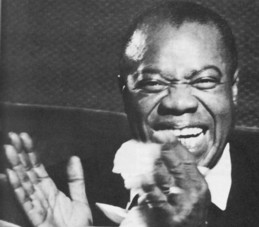
It's probably better known nowadays since Louis Armstrong's recording from the 50s was used on the soundtrack of Sleepless In Seattle (1993) . That leisurely baritone, just rough enough around the edges, plays against the sweet melody in a wistful kind of way, and of course there's a trumpet solo that bursts onto the scene as a bonus at about 1 min. 30 secs. All in all, it's a satisfying result.

(It reminds me of the way John Lennon's delivery adds some edge to that sad, sweet love song Baby It's You, when compared with the original version by The Shirelles.)

I'd always assumed A Kiss To Build A Dream On was from the 30s (it sounds as if it's from the 30s), so I was surprised to find that its first appearance seemed to be in a 1951 film, The Strip, sung by Louis Armstrong. It does have a copyright date of 1935, but I could find no earlier versions.

But, as is often the case, Joop Jansen had an answer when I asked at The Originals forum.

It turns out that A Kiss To Build A Dream On was originally a song called Moonlight On The Meadow. It was written by Kalmar and Ruby for the Marx Brothers film A Night At The Opera (1935), but it was never used. Oscar Hammerstein took the song and wrote new lyrics for The Strip (1951), and that's when it became A Kiss To Build A Dream On.

04 February 2006

▶︎ Everybody's Gonna Say... We're Doing Fine

We're Doing Fine is a Dee Dee Warwick gem from 1965, written by Horace Ott. It had already been recorded in Britain by Billy J. Kramer (single, 1966) and by Chris Farlowe (The Art of Chris Farlowe, 1966).

It's hard not to notice that it's a fair bit like Everything's Gonna Be Alright by P.P. Arnold, a song I first heard briefly in the film A Room For Romeo Brass (1999). P.P. Arnold released it on a single in 1967, her first on the Immediate label, and it was on her album The First Lady Of Immediate (1968).

Everything's Gonna Be Alright (the line that gets stuck in your head goes Everybody's gonna say that it's all right) was written by Immediate founder and producer Andrew Loog Oldham with David Skinner, who was one half of another Immediate act, Twice As Much.

The opening verses are more or less identical, melodically and rhythmically, and the lyrics have a lot in common: Everybody wants to know if everything's all right (Dee Dee Warwick) cf Everybody's gonna say that everything is all right (P.P. Arnold). After that, the choruses take off in different directions.

It's hard to say whether Oldham and Skinner were writing a sequel, or a dip o' the lid to We're Doing Fine, or whether it was a borrowing, unintentional or deliberate. (We're Doing Fine wasn't unknown at Immediate: Chris Farlowe's 1966 version was on the same label.)

Whatever the answer, I like both songs a lot: Dee Dee Warwick's is a classic, seamless US soul production of the era, while P.P. Arnold's is a bit poppier, with a big chorus-and-orchestra build-up in the first 30 seconds.

P.P. Arnold was a UK-based soul singer (you may find her filed, inevitably and retrospectively, under 'Northern Soul') who came to Britain with Ike and Tina Turner and stayed to record such hits for Immediate as First Cut Is The Deepest, Angel Of The Morning and [If You Think You're] Groovy, this last written by Steve Marriott and Ronnie Lane of The Small Faces, who also provided the backing. Down here, Groovy charted in Melbourne at #8.

Dee Dee Warwick is Dionne Warwick's sister: or should that be Dionne Warwick is Dee Dee Warwick's sister? Dionne herself reportedly said, "Dee Dee is the real singer in this family," but she missed out on big commercial success. Not fair, really, when you hear her sing.

▶︎ The bigger the star, the clunkier the website?

My policy is to avoid bagging other people's websites (people in glass houses and all that) so I'm not about to give examples, but I can't help thinking rich and famous musicians are sitting ducks for expensive web designers who tell them that a big, important star has to have a big, important website with lots of stuff on it.

Your expectations drop when you see the slow-loading Intro Page, with a "Loading - please wait" message and a progress meter for you to watch (isn't that so 1990s?). Of course there's a "Skip Intro" button: does anyone, ever, not skip the intro?

At some stage a song suddenly starts playing, right over the top of the music that's already playing on your computer, and you can't turn it off without quitting the site.

There's lots of flashy, 3-D graphic art that moves around and pops up, stuff that only a Big Star can afford. The site might be so full of Big Star Stuff that the whole thing freezes up and you have to restart your browser. (And of course, you're so impressed that you'll immediately return to the site and watch that lovely Intro load all over again, right?)

As to content, don't expect the Discography to waste space on those musty old 45s. There'll be a page of the latest compilation CDs (with links to The Store), and promos for that new album where all the old songs were recorded again properly, with new arrangements, in Nashville, with the artists' grown-up kids who are trying to break into the business...

Ah well, I guess my own site might go too far the other way: to some tastes, it's probably too text rich, and my discreet little black & white snapshots might not satisfy some people's urge for colour and spectacle.

So let's move on, get positive, and link to some artists' sites that, while they are sufficiently illustrated, are not overloaded with slow-loading eye candy, and have information that is to the point and easily accessed.

Some official musicians' sites I like. (Update 2025: a few have disappeared over the years)

The Five Americans
Rick Nelson 
The Monks
Emitt Rhodes
Pernice Brothers

And some good unofficial sites, by admirers or researchers:

The Van Morrison Website
Union Songs (Bjorn & Benny from ABBA)
ByrdWatcher
The Peter Doyle Website
The Band


15 October 2005

▶︎ Cicadas and Flies: Bizarro Merseybeat World Down Under

Earlier, I wrote about the phenomenon I like to call Bizarro Shadows World Down Under. When it became unfashionable to emulate the Shads and The Ventures, bands in Australia (and they weren't the only ones around the world) caught the Merseybeat bug.

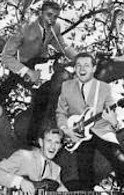
Here, Sydney musician and researcher Terry Stacey discusses Sydney band The Cicadas (pictured) in that context:

The Cicadas were one of the first of Australia's bands to be influenced by The Beatles. Other early Beatle bands were Melbourne's Flies (which gave the world Ronnie Burns), Sydney's Rajahs, who had transformed themselves from 50s rocker Dig Richard's backing band, The R'jays, by putting on Beatle wigs and turbans, and The D-Men, whose main claims to fame were that they were the first resident band at Sydney's first disco, Beatle Village, and came from the Sydney suburb of Liverpool (their lead singer Freddie Cooke later migrated to Melbourne, joined The Vibrants and changed his name to Marc Leon).

The Cicadas, formed in 1963, were originally an MOR band doing TV variety shows under the name The Hi-Fi’s until the Merseybeat boom arrived. They signed to RCA and released their first and most successful single, the Carter-Lewis song That's What I Want in 1964.

This had been a minor hit for UK band The Marauders
in 1963 and, unusually, they covered both sides of the Marauders single, the flipside being Hey Wha' D'Ya Say, for their own single.

They then put out a second single, written by veteran rocker, then RCA's A & R manager, Johnny Devlin, with a similar Beatles title, I Need You. This was a minor hit in Sydney.

After a further, unsuccessful, single, a cover of anothe
r Marauders single, Carter-Lewis's Always on My Mind, they relocated to the UK and changed their name to The Gibsons. They released a number of singles on various labels there, including the catchy The Magic Book (rated elsewhere as one of 1966's better singles).

Although they outlasted their Beatle boom contemporaries back in Australia, none of their singles was successful. They put out their last single in 1967.

(Contributed)