21 June 2005
▶︎ Popular at PopArchives
I don't have any traffic counters at the site, but early in April I started putting in links to HMV Australia if they stocked a listed song on CD. I can get traffic reports from HMV daily or over a longer period, so although it doesn't measure actual visits to my pages, it might be an indicator.
Looking at the statistics so far, half a dozen songs have attracted the most on-clicks. The first two are way ahead of the others (about double the clicks for #3).
1. I've Been Everywhere
What can I say? People still love this song, and it's also well-known through versions by Hank Snow and Johnny Cash. (See below: 'Obscurities? Forget 'em! We want 'I've Been Everywhere') We even heard it on one of our local radio stations this very morning.
2. The Lion Sleeps Tonight
This might have something to do with the PopArchives page being linked from a PBS page about the history of the song.
3. Everlasting Love
This makes sense: a hugely popular song world-wide, much recorded, and at least eight versions have charted around Australia. It even turned up on the soundtrack to the Bridget Jones sequel.
4. Je T'Aime (I Love You)
This is Abigail's version of the Serge Gainsbourg song, Je t'aime moi non plus, which he recorded with Jane Birkin. Perhaps Jane Birkin's appearances in Australia have increased interest in it.
5. She Wears My Ring
Another much-recorded song, including a version by Elvis.
6. Day By Day
From the musical Godspell. I can't see any big, current production of this. Probably just another enduring favourite.

▶︎ Barry Ferber and The Bearded Beetle.

The Bearded Beetle, a record by The Beetle Bashers (they spelt it beetle), came out on Melbourne's W&G label in 1964, one of numerous Beatles tribute and novelty records that surfaced world-wide in the wake of Beatlemania. Most sank without trace, but two versions of We Love You Beatles charted in Melbourne, and for some reason ex-Cricket Sonny Curtis’s A Beatle I Want To Be sticks in my memory.
The Bearded Beetle was written and sung by Melbourne disc jockey Barry Ferber. The title came from the nickname he gave to his bearded panel operator.
At a time when 3UZ was the dominant Top 40 radio station in Melbourne, Barry Ferber ran a record show over at the more traditional 3DB. He called himself the Mellow Fellow: the hip American deejay talk sometimes heard on 3UZ was not his style at all.
Ferber was a witty bloke who had a way of sending things up, a bit in the tradition of Graham Kennedy, so it wasn’t surprising when he put out a record that took the mickey out of the current teenage craze. These days, his name is still associated with the Beatles through George Harrison, whose 1964 message to him is anthologised on CD.
The Bearded Beatle and its flipside, The Beetle Bashers Beat, were both written by Barry Ferber, and W&G even issued a further Beetle Bashers single in 1965, co-written by Ferber, Don’t Make Love In The Cornfields. Neither was a hit, but I don’t imagine rival stations would’ve given them much airplay. (Both records are catalogued at Screensound Australia's Second Wave discography.)
Along with Don Lunn at 3UZ, whose American-influenced patter offered a complete contrast, Ferber was my favourite local deejay. So I was overjoyed to find a complete 60 minute Barry Ferber program archived at Bluehaze Solutions' Multimedia Vault.
This is good value: an unedited January 1963 countdown of 1962’s Top 20, sponsored by Love’s department store. It’s great to hear Ferber again, but he’s playing it straight here, plugging the sponsor, reading the commentary, keeping it tight, no send-ups. (It may even be a pre-recorded show.)
Barry Ferber went on to management, first at 4GG at the Gold Coast in Queensland when it first went on air, and later at Radio Fiji. More recently, he's filed columns from Las Vegas for the Gold Coast Bulletin (see above).
But who was that bearded panel operator? [For the answer see the follow-up post More on the Bearded Beetle. The comments are full of further information, too.]

Picture: Barry Ferber, columnist (story in the Melbourne Observer, 20 October 2004).
18 June 2005
▶︎ Bizarro Shadows World Down Under
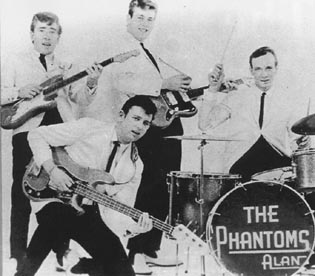
Standing in the shadow of The Shadows:
Melbourne band The Phantoms, from Canetoad's W&G Instrumental Story.
How many Australian and New Zealand bands of the 60s started out playing instrumentals in the style of the Shadows but transformed themselves in the wake of Beatlemania? See, for a start, The Strangers, The Questions, The Cherokees and The La De Das.
When a bunch of teenagers formed a band in the early 60s their main passion was often to emulate The Shadows or The Ventures (not only in Australia: see my post ¡Viva Los Shads!). Apache and Walk, Don’t Run were standards of the repertoire.
In Australia, this amounted to something like a movement, a phenomenon I like to call Bizarro Shadows World Down Under.
Aussies were always fond of a guitar-based instrumental. The Shadows were as big here as they were in the UK, and they were still charting alongside the Beatles into the mid-60s: their last hit in Oz was Bombay Duck in 1967 (#3 Adelaide, #10 Brisbane). The Americans preferred The Ventures, but we liked them as well: best of both worlds, down here. When surf music came along we took to it in a big way, and it melded in nicely with the guitar instrumental genre.
We also had our local heroes. Sydney steel guitarist Rob E. G. was often on the radio and the charts in the early 60s, often (but not always) with his own compositions: Railroadin', Si Senor (I Theenk?) and 5, 4, 3, 2, 1, Zero. In 1963 Sydney band The Atlantics produced Bombora and The Crusher, two stunning examples of the surf instrumental that give Pipeline and Wipeout a run for their money. The Joy Boys - without Col Joye - had a national Top 5 hit in 1962 with Southern ‘Rora, inspired by, of all things, a new Melbourne-Sydney train service.
Melbourne band The Strangers first charted in their home town with a guitar version of Frankie Laine’s hit Cry of the Wild Goose (1963), a far cry from the soul-tinged vocal pop of 1968’s Happy Without You. Progressive New Zealand band the La De Das were, in their embryonic form, a high school band called The Mergers who played Shadows-styled instrumentals. At the website of guitarist Rod Stone, later with The Playboys and The Groove, you can hear a snatch of his 1962 version of Skye Boat Song, recorded in New Zealand as a 17-year-old in immaculate Shadows style.
It’s not that the instrumental bands didn’t sing at all, but looking back it’s hard to avoid the idea that it was cooler, even more manly, to pick out those precise guitar instrumentals than to sing soppy love songs.
There are a number of Bizarro Shadows World Down Under tracks on W&G Instrumental Story, released by the Australian reissue label Canetoad. W&G was a Melbourne record label.
Some of these tracks sound a bit cheesy, even clunky, at this distance, but that’s a feature of instro-guitar in general. Even so, there’s a good mix of remakes and originals that often stand up well beside their British and American models.
About half the tracks are by Melbourne showband The Thunderbirds, who were really too big, too brassy and too versatile to be put strictly in the mould of the Shads. Their version of The Rebels' Wild Weekend is an Aussie instrumental classic.
Otherwise, tracks by The Cherokees (Thundercloud), The Chessmen (The Rebel [Johnny Yuma]), The Breakaways (The Wheel), The Strangers (Undertow) and The Phantoms (Stampede) wouldn’t have sounded out of place on a Shadows or Ventures album.
When Beatlemania hit, many Aussie instrumental bands did just what the boys in my Australian town did: they shampooed their hair, brushed it down over their foreheads, and never again darkened the doors of traditional barbers’ shops.
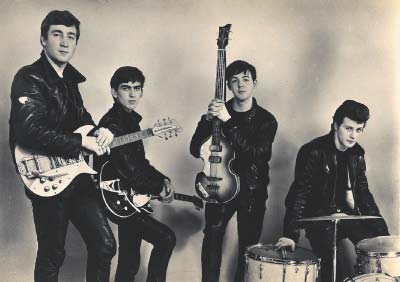
Pictures of the Beatles before Ringo illustrate the contrast. Pete Best looked fine and he still had a loyal following. He had that detached, moody, brushed-back look that went back to James Dean and the late-50s teen idols, but (unless my perception is skewed by hindsight) he already looked oddly out of place.
More than just changing the idea of what looked cool, Merseybeat made singing an imperative. The Strangers developed a hip pop sensibility that gave them vocal hits in the late 60s with Melanie Makes Me Smile, Western Union and Happy Without You. The Cherokees dabbled in a number of styles, but they had their greatest success with the comic revivals Oh, Monah and Minnie The Moocher that for some reason never seemed out of place on the charts of the late 60s.
The Atlantics ventured into Brit Invasion recycled R&B with the likes of I Put A Spell On You, featuring Johnny Rebb, an experienced rock’n’roller who had joined the band, and Rob E.G. re-emerged as Robie Porter, this time singing on his records (When You’re Not Near). Sydney band, The Questions also hired a vocalist, and his name was Doug Parkinson.
You thought I was going to say, "And the rest is history...", didn't you?
_______________________________
14 June 2005
▶︎ See you 'round, like a record: producer Phil Chapman
I asked Phil Chapman, one of the record's producers, about Little Nell's See You Round Like A Record. He confirms that co-producer Brian Thomson, a notable Australian stage designer, came up with the title and it was indeed based on the catchphrase of an Australian disc jockey.
The three producers met while working on The Rocky Horror Show in London: as I noted below, Little Nell was a cast member. The team cut a series of singles with Nell in the second half of the 70s.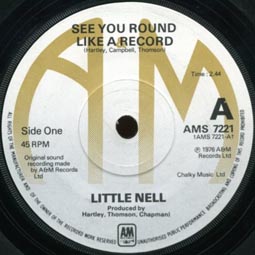
Little Nell's round record
Subscribe to:
Posts (Atom)