15 October 2005

▶︎ Cicadas and Flies: Bizarro Merseybeat World Down Under

Earlier, I wrote about the phenomenon I like to call Bizarro Shadows World Down Under. When it became unfashionable to emulate the Shads and The Ventures, bands in Australia (and they weren't the only ones around the world) caught the Merseybeat bug.

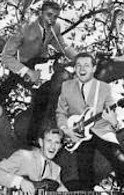
Here, Sydney musician and researcher Terry Stacey discusses Sydney band The Cicadas (pictured) in that context:

The Cicadas were one of the first of Australia's bands to be influenced by The Beatles. Other early Beatle bands were Melbourne's Flies (which gave the world Ronnie Burns), Sydney's Rajahs, who had transformed themselves from 50s rocker Dig Richard's backing band, The R'jays, by putting on Beatle wigs and turbans, and The D-Men, whose main claims to fame were that they were the first resident band at Sydney's first disco, Beatle Village, and came from the Sydney suburb of Liverpool (their lead singer Freddie Cooke later migrated to Melbourne, joined The Vibrants and changed his name to Marc Leon).

The Cicadas, formed in 1963, were originally an MOR band doing TV variety shows under the name The Hi-Fi’s until the Merseybeat boom arrived. They signed to RCA and released their first and most successful single, the Carter-Lewis song That's What I Want in 1964.

This had been a minor hit for UK band The Marauders
in 1963 and, unusually, they covered both sides of the Marauders single, the flipside being Hey Wha' D'Ya Say, for their own single.

They then put out a second single, written by veteran rocker, then RCA's A & R manager, Johnny Devlin, with a similar Beatles title, I Need You. This was a minor hit in Sydney.

After a further, unsuccessful, single, a cover of anothe
r Marauders single, Carter-Lewis's Always on My Mind, they relocated to the UK and changed their name to The Gibsons. They released a number of singles on various labels there, including the catchy The Magic Book (rated elsewhere as one of 1966's better singles).

Although they outlasted their Beatle boom contemporaries back in Australia, none of their singles was successful. They put out their last single in 1967.

(Contributed)

14 August 2005

▶︎ The Lampe File

Since posting about the elusive Nicholas (aka Nick) Lampe I've had an email from Robert Thompson in Melbourne who has been trying to research the 70s singer-songwriter for some
time. He has contacted several personnel from the album, but they all say they lost contact in the 70s. One said Nicholas Lampe was working as a social worker on the East Coast in the 70s.

I posted a question to the Spectropop Group without any response, and there's usually somebody there who can answer just about anything.

It sounds as if Nicholas Lampe may've done a J.D. Salinger: as Robert points out, he might've just turned his back on the music business and chosen to be left alone. That sounds likely, and I guess that's as much as we can add to the Lampe file for now.

(Update: See At Last: The Nick Lampe Story.)

11 August 2005

▶︎ Shelley Pinz (Rochelle Pinz)


A first cousin of Shelley Pinz emailed last week to tell me more about the New York songwriter, poet and psychotherapist, born in 1944, who died last year.

As a songwriter Shelley Pinz is probably best known for the Lemon Pipers' 1968 hit Green Tambourine, written with her frequent collaborator Paul Leka. They wrote some follow-ups in a similar vein, including Rice Is Nice, Jelly Jungle (Of Orange Marmalade) and Pink Lemonade. This was was when Pinz and Leka were writing pop songs for Buddah, the Kama Sutra label's spin-off, and they continued writing together into the 70s.

In Australia, two other Shelley Pinz songs surfaced through local cover versions in 1968. She and Paul Leka also wrote You Are The One I Love, originally by Adam's Apples [listen], covered here by The Groove, and she co-wrote Happy Without You (this time with Kenny Laguna), originally by The Sound Judgment [listen] but remembered in Australia as a classic oldie by The Strangers. Both songs charted in Melbourne - the base city of both bands - and in Brisbane.

As Rochelle Pinz (using her full given name), Shelley Pinz was a psychotherapist specialising in the use of music, art and poetry. She held a Masters degree in social work, and in the late 90s she published a volume of poetry and lyrics, Courage to Think. WoodstockLive has some notes about this (although the audio link didn't work for me).

The best account I’ve found about Shelley Pinz the songwriter is in her own words from 1999 at StocksandNews.com (archived page), where she recalls how she got into the business while she was still a poetry-writing college student.

She tells about the inspiration for Green Tambourine, just before meeting with Paul Leka in the Brill Building precinct of New York:
In early Spring, 1966, while standing in front of the Brill Building I watched a man holding a tambourine begging for money. I wrote a poem about him and called the poem, 'Green Tambourine.' I added it to my lyric collection…. Sometimes I wonder what happened to the man in front of the Brill Building, holding a tambourine begging for money. I remember writing the lyric, ‘watch the jingle jangle start to shine, reflections of the music that is mine. When you toss a coin you'll hear it sing. Now listen while I play my Green Tambourine’ as if it were yesterday..; in the 60s, on the streets between Seventh Avenue and Broadway there was a magic one could only imagine.

Green Tambourine was a worldwide hit (#1 USA, Top 10 UK & Australia, #3 NZ), but Happy Without You and You Are The One I Love would be better known in Australia than in the US. The American originals are obscurities, although the Adam's Apples recording of You Are The One I Love has been given new currency by the Northern Soul movement.

Shelley Pinz is listed at BMI under four variations of her given name: Rochelle, Shelley, Shelly and Chele, but ‘Shelley’ seems to be the preferred spelling as a songwriting credit,

--- 

Adam's Apples - You Are The One I Love.mp3

The Sound Judgment - Happy Without You.mp3

Label scan from Margaret G. Still, thank you.
---

Update 7 March 2020:
Essential reading!

JCM, another friend of Rochelle 'Shelley' Pinz, has emailed his memories of her:

❝ I was in my mid teens in Atlantic beach when I and a friend met 'Shelley' ..we would shovel her snow & she'd invite us in and make us herbal tea. Some days, we'd stop by & say hello, she'd make us tea. We were kids...to me, why not?

16 July 2005

▶︎ Nail that original!

I can’t explain this obsession some of us have about tracking down the original version of every song ever recorded in the universe or, in my case, Australia. Either you get it or you don’t: maybe Arnold Rypens would have a better idea. But here are four rules of song history that I’ve learnt along the way:

1. After you nail an original, wait: someone, some day, will email you with an earlier version.

2. Ask the singer, producer or songwriter for information, but don't be surprised if they turn out to be wrong.

3. There's a bloke in Belgium or Finland who knows more about this stuff than Australia's Rock Brain of the Universe.

4. If you've dug up a really obscure original version of a well-known song, don't expect friends, family, neighbours or the guy at the post office to get excited about it or even understand why you bothered in the first place.

(Also on the About page.)